
Tag: Christianity

The one thing that has challenged my faith

13350239_624569961040640_8092507861845382051_oA stranger knocked on my door one day.

“Hello, Mr. Acker. My name is Brother Turnbow.”

The elderly preacher was doing what he had spent his entire ministry doing. He was knocking doors to share the Gospel. I welcomed him to sit with me, told him I was also a pastor, and discussed with him the scriptures and the state of the world today.

The year was 2011, and I had just moved into my new house. Bro. Turnbow had gotten my name from the list of new water accounts opened with the city of Early. My heart had been heavy that week thinking about the rise of sin, and the animosity toward Christianity in society. Sin is taking our country down the hill of destruction, but the loudest voices in our society blame Christianity for the downfall.

That’s why a certain stanza from Marc Schultz’ song, “I have been there,” resonates with me:

He’s been a pastor 20 years, but tonight he sits alone and broken-hearted in the corner of the church.

Trying to change a fallen world, with his words and with his wisdom but it seems like it is only getting worse.

“Bro. Turnbow,” I asked, “Do you ever feel obsolete?”

Bro. Turnbow smiled and said, “As long as you preach God’s word, you are never obsolete.”

The problems of the world all come from unbelief. People distrust God, so they sin against Him, which causes all kinds of problems. It has been that way ever since Genesis 3, where Adam and Eve ate the forbidden fruit because they thought that God was holding out on them. Since then, the world has been in disarray, suffering from the effects of sin.

It is tempting to watch the demise of western civilization and conclude that, the end time is here, and Christ will soon return. He very well may, but to give up on the calling God has placed on your life is not only a dereliction of duty, but it expresses the same lack of faith shown by the generations before who “gave up” because of the changes in society, saying “Even so, come Lord Jesus.”

I was reading Luke 5 in my personal devotional time the other day, and Luke 5:17 struck me.

“And it came to pass on a certain day, as he was teaching, that there were Pharisees and doctors of the law sitting by, which were come out of every town of Galilee, and Judaea, and Jerusalem: and the power of the Lord was present to heal them.”

The power of the Lord was present to heal them. Heal who? The Pharisees and doctors of the law who sat by, watching in unbelief as Jesus taught the word of God and ministered to the people. These people were diametrically opposed to the message Christ brought, and his rise among the people. He was a threat to their influence and lifestyle, so they opposed Him.

Yet Luke 5:17 seems to indicate that the Lord had the power to heal their unbelief. And if the power of the Lord can heal the unbelief of some crotchety old Pharisees in the first-century AD, imagine what he can do for a world blinded by the selfish pursuit of pleasure.

Where my faith has fallen short in the past is that I failed to believe that God is the one who reaches people, convicts them, then redeems them. My faith has fallen short in believing that God can do that, and that He will do that. My faith has fallen short in believing that God WILL save, not just that He can.

That unbelief is in my past. I have repented from that sin, and now I am looking forward to seeing God move in mighty ways.

My wife once said, “True faith is realized when you no longer have to be the solution to the problem.” It would help us Spiritually, psychologically and emotionally to remember that the battle is the Lord’s. He will be the One who effects the change.

Our jobs are the same as the Apostles in Acts 5, who were told to “Go, stand and speak the words of this life.”

So, share the Gospel. Defend the faith. Preach the scriptures. But remember, the results are not up to you. Once you realize that, you’ll more fully understand “freedom in Christ.”

May God bless you in your Spiritual walk today.

The Lost Art of Leisure

16708472_10211627013496723_1898660107827657514_n“The world went and got itself into a big ole hurry,” wrote Brooks Hatlin to his former cellmates at Shawshank prison in the movie, The Shawshank Redemption. Brooks had served a 50 year sentence in Shawshank before being paroled in 1954.
While the pace of life in 1954 seems like a leisurely dream today, it moved at a breakneck speed for those accustomed to the pace of life in 1904, like Brooks.

The more time passes, the faster the pace of life. It’s not your imagination, and it’s not the effect of age. Life is really more hectic today than it was in 1954, or 1984, heck, even 2004.

The fast pace of life today would surprise futurists of the 1960s, who predicted that computer technology and automation systems would reduce Americans’ workloads, resulting in more time for leisure. Instead, computer technology and automation systems led to large scale layoffs. While those laid-off workers ultimately found new work in a growing economy, the fact remains that automation didn’t cut down on workload, but rather increased the demands that employers placed on workers.

It’s a far-cry from the world envisioned by Walter Cronkite on his 1967 CBS News special which looked forward to life in 2001. Instead of a life of leisure, Americans are spending one of the most prosperous and technologically advanced periods in world history trying to keep up with rising demands.

Lost in all this is the art of leisure. In time past, workers had weekends off. Fathers took their kids fishing, or to their Little League baseball games. Extended families gathered for cookouts in the back yard, weekend trips were taken, and nobody batted an eye when you took your annual two-week road-trip vacation.

Offices observed all the national holidays, and life really slowed down around Christmas, with many companies offering paid time off between Christmas and New Year’s.

All of that has gone by the wayside. Vacations are now four-day adventures in resorts, hotels, cruises, or the ever-so-popular “stay-cation,” where you take time off, but never leave the house.

At one time stores were closed on Sundays. Today, they remain open. Retailers open on Thanksgiving to get an early start to the Christmas shopping season.

All of this has built into a perfect storm where Americans not only face ridiculous expectations at work, but also live their off-time in a frenzy, trying to accomplish as much as possible in as little time as possible, all while neglecting to rest.

During a recent interview with Michael P. Foley, author of The Politically Incorrect Guide to Christianity, I asked what we could do as Americans to defend and preserve Christmas traditions. Foley said that we can preserve and defend Christmas simply by taking the time off and enjoying the holiday. He noted that we used to take Christmas off, as well as every Sunday, for leisure, adding that God gave us one day of rest per week.

He said if we truly want to preserve Christmas, we should observe it by taking the time off and enjoying that time with our families. Obviously, if you are in the military or are a first responder, this may not be an option. For those of us who have this option, however, we should take it.

It’s time that we all stop and take a look at what’s important in life. Look at your commitments, prioritize what’s most important to you, then budget your time and money accordingly. As you do this, set aside time for leisure. Take a day a week where you have no commitments, where you take a day to do nothing. Go fishing. Play a board game with the kids. Go to the local park. Take leisure.

Doing so doesn’t make you lazy. It brings you into harmony with God’s plan, which offers a day of rest every week, and periodic rest throughout the year. As Psalm 127:2 says, “He giveth his beloved sleep.”

Obey God and do as you please

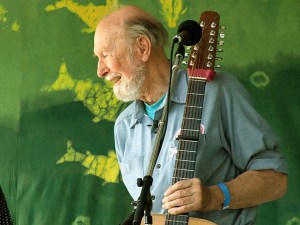
Pete_Seeger2_-_6-16-07_Photo_by_Anthony_Pepitone
Photo by Anthony Pepitone

Pete Seeger is probably the most influential man whose name you probably have never heard. A social activist of the 1960s, he wrote songs promoting environmentalism, civil rights, the counterculture, and songs opposing the Vietnam War.

He popularized the song, “We Shall Overcome,” which became the anthem for the Civil Rights Movement, and his song “Turn, Turn, Turn (To Everything There is a Season)” became a major hit for the Byrds, and a musical standard for the 1960s.

The song, “Turn, Turn, Turn,” was taken almost verbatim from Ecclesiastes 3 in the King James Bible. The song itself was used as an anthem to call for an end to the Vietnam War, with the final line stating, “a time for peace, I swear it’s not too late.” Those who listen to the song can find themselves transported to a peaceful state of mind, relaxing and just enjoying the moment.

The irony of “Turn, Turn, Turn” is that Seeger rejected the Bible as scripture. He did not believe the Bible is God’s word, and he thought much of the book was a collection of folk tales and poetry. In an interview with Paul Zollo, which later appeared in the book, Songwriters on Songwriting, Seeger discussed his views on the Bible:

I don’t read the Bible that often. I leaf through it occasionally and I’m amazed by the foolishness at times and the wisdom at other times. I call it the greatest book of folklore ever given. Not that there isn’t a lot of wisdom in it. You can trace the history of people poetically.

Ironically, Seeger’s biggest hit came by setting music to the wisdom of Solomon in Ecclesiastes 3. The idea came after Seeger’s publisher complained that he was unable to sell the protest songs which he was writing. Seeger, a social activist at heart, put the music to the scripture, hoping that the publisher would hear a Top-40 hit, and that the listeners would hear a call for peace.

Further irony is that a song that became an anthem for peace in the 1960s also proclaimed there was a time for war, a time to kill, a time to hate, and a time to cast away stones. Also, there was a time for peace, a time to heal, a time to love and a time to gather stones together.

The opening lines say it all, “To every thing there is a season, and a time for every purpose under heaven.”

Seeger rejected the Bible as God’s word, and as such rejected the one who could put more power into those lyrics than David Crosby or Roger McGuinn ever could.

Ecclesiastes is a popular book among atheists and agnostics because of its seemingly humanistic approach to life. In many places, the book claims that life is empty, and none of man’s works will last for eternity. Therefore, one should simply enjoy the simple pleasures of life and the fruit of his labor. That approach to Ecclesiastes is extremely dangerous, because it plays right into the error that the writer was warning against.

Taken in its context, words of wisdom from a King who wanted his people to live with the enlightenment of the Lord’s wisdom, Ecclesiastes teaches that life outside of God’s presence is empty. It’s pointless. It is temporary and the struggles of life are futile.

The lesson in all this is that God is in control, and there is nothing we can do to add to, or to take away from, the plan that He is working on this Earth. Therefore, we should be content to live with the blessings God has given us, to learn the purpose of the seasons of life we endure, and to obey and reverence God.

Furthermore, we should eat and drink, and enjoy the good of all our labor, for it is the gift of God (Ecclesiastes 3:13). While we do that, we should give thanksgiving to God for that gift.

Or as one theologian put it, “Obey God and do as you please.”

Had Seeger understood this concept, he would not only have seen that the wars, conflicts, and times of peace and prosperity served God’s purpose, but he still would have been free to pursue his social agenda of equal rights and preserving God’s creation. Instead, he will be mildly remembered as the man behind a happy little ditty from the 1960s.

God created you with a purpose. Ephesians 2:10 says that we are created in Christ Jesus unto good works which God before ordained that we should walk in them. In giving us that purpose, he gave us passion for that purpose and the talent to pursue it. Do not separate your spiritual/church life from your daily life. The whole of your persona was built in when God formed you in the womb.

Pixar has us coo-coo for Coco

Coco_(2017_film)_posterToy Story. Finding Nemo. Cars. Up. Wall-E. Iconic Pixar movies that defined the childhood of a generation, and gave parents precious memories with their kids. These films moved us in theaters, and babysat our children once released to home video.

With each classic Pixar released, it was hard to imagine that a better film could be made. Then, without fail, Pixar’s next movie would elevate the theatrical experience to the next level. Their latest release, Coco, is no different.

The film centers around Miguel, a 12 year old boy growing up in Mexico who dreams of being a famous musician, even though his family forbids music after his great-great grandfather abandoned the family to pursue a music career. Miguel idolizes Ernesto de la Cruz, a popular film/music star of the early 20th who died years earlier in a tragic stage accident. De la Cruz hailed from Miguel’s hometown, furthering the young boy’s fantasy that one day he could be as famous as the Mexican film/music icon.

Through a series of sordid events, Miguel comes to believe that he is the great-great grandson of De la Cruz, and when the local talent show begins at the town plaza, he tries to borrow De la Cruz’ guitar from his grave site. That decision sets off a chain reaction that lands Miguel in the Land of the Dead during the Mexican holiday of Dia de Muertos, the one day the dead can return to the land of the living to visit their descendants.

The adventure sees Miguel reunited with his ancestors, separated from his ancestors, and reunited with De la Cruz, where he learns what is truly important to him. His adventure changes the Land of the Dead, as well as the Land of the Living forever.

Coco is Pixar’s best movie yet, because it touches people of all backgrounds. There are characters with which kids, adults, and seniors can identify. If I could have taken my dog, there would have been a character for her. The movie relates to career successes, sacrifices for family, hopes, dreams and fears. There’s not one part of the human spirit, save for a connection to God, that this film doesn’t touch.

The movie experience was so uplifting that I stayed and watched the credits.

Among the many themes found in the movie, the one that really stood out to me was the need to be remembered. According to the movie, (and Mexican legend), on Dia de Muertos, the dead are able to return to the land of the living to visit their descendants provided that those descendants post a picture of them on an ofrenda, and remember them. This ofrenda also includes things the dead ancestor enjoyed during life, like food, or musical instruments.

Those in the Land of the Dead whose families do not post pictures or ofrendas to them are denied entry into the Land of the Living, and are stuck in the Land of the Dead without family or friends.

If no one on earth remembered you, then you also vanished from the Land of the Dead into non-existence. Therefore, it was important to each resident of the Dead to be remembered, and to have their family post an ofrenda in their honor.

Families in Mexico still celebrate this holiday. It speaks to the natural fear of death, the wish for an eternal existence postmortem, and the need to be remembered. It is on these aspects of the human existence that Coco spoke the most clearly. Coco also addressed our desire to remember our loved ones fondly who have passed on before us.

One of the most difficult things to deal with in life is death. It’s hard to face our own mortality, and it is hard to deal with the loss of a close friend or family member. Dia de Muertos is a way Mexican residents have learned to cope with the loss.

However, scripture tells us that we can all have an eternal resurrection if we know Jesus Christ as our personal savior. Scripture also foretells of a day described by African American preachers in the South as “That glad gettin’ up morning.”

1 Thessalonians 4:16-18 says:

For the Lord himself shall descend from heaven with a shout, with the voice of the archangel, and with the trump of God: and the dead in Christ shall rise first: Then we which are alive and remain shall be caught up together with them in the clouds, to meet the Lord in the air: and so shall we ever be with the Lord. Wherefore comfort one another with these words.

The day is coming when the Lord will reunite us with our loved ones. Moreover, we will be reunited with the Lord Himself.

These promises are made to all who repent and trust Jesus Christ as their personal savior. Have you made that decision? If you have, then the biggest and best family reunion ever planned is coming your way.

Take heart. This life is merely a preparation for the next. Live accordingly.