One thing I learned from the insurance industry, a lesson that was reinforced in business school, was the importance of having a plan, then focusing on the plan, not the over-arching goal.
My regional sales manager at State Farm used to say, “A goal without a plan is a pipedream.”
Yes, she was brutal, but she was right.
In every insurance position I worked, we were given production goals. The trick to hitting those goals was to formulate a plan based on statistical probabilities.
“If only 7% of the people I call answer the phone, and if I’m only able to sell half of them, and I am required to sell 35 policies this month, then that means that I will need to place 1,000 phone calls this month in order to hit my sales goal.”
So, instead of looking at the leader board and seeing how many sales I’ve made, or how many I haven’t, the key to success was to track my daily activity to ensure that I was on my way to making those 1,000 calls. More often than not, if I followed the plan, success followed.
As I talk to people about their New Year’s resolutions, I am hearing the same things. “I want to save more money.”
“I want to lose _____ pounds.”
“I want to spend more time with my kids.”
The key to success in these resolutions is to build a plan to meet these goals, then make the plan your resolution.
So, instead of saying “I want to save more money,” say, “My New Year’s resolution is to put _______ dollars into my savings account every month.”
Instead of “I want to lose 50 pounds,” come up with a diet/exercise regiment that will get you there, then make that your resolution. “My New Year’s resolution is to eliminate processed sugars, don’t drink my calories, and to walk one mile per day.”
If your resolution is to spend more time with your kids, put a numeric value on that. “My resolution is to spend 30 minutes with my kids daily.”
If you frame your resolutions in quantifiable actions like this, broken down to a level where you can measure and achieve progress daily, you’ll have more success in following and realizing your resolutions.
As for me, my resolutions are as follows.
Read through the Bible (Genesis to Revelation)
Walk one mile per day.
Consume 1,500 calories or less every day.
Invest $300 per month.
Obtain my Class B drivers’ license by June.
I believe these resolutions will help me achieve my goals of growing Spiritually, becoming healthier physically, and being in a better financial situation by the end of 2026.
As written works of literature become more familiar, we often lose the lessons the authors hide in the details. Whether you are discussing a familiar Bible story, or a piece of classic literature, the tendency is to drift toward the obvious story arc, and the moral thereof, missing the little nuggets and Easter eggs hidden along the way.
Such is the case with “A Christmas Carol,” by Charles Dickens.
So many of the details used in the story are often interpreted by the reader to simply paint the picture of who Ebenezer Scrooge was, and by extension who his late partner Jacob Marley was.
Scrooge was a heartless, bitter miser, no doubt formed by his meager, loveless upbringing and his pride in his own business dealings. Marley was like Scrooge, but being dead, was now condemned to an eternity of guilt, shame, and torment as a result of his sins against humanity.
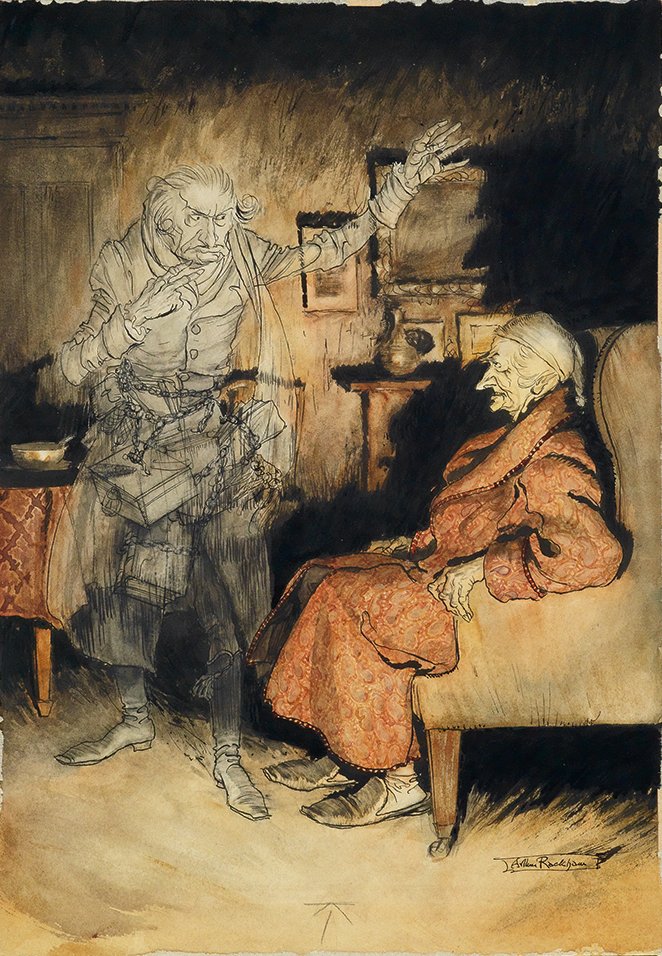
The sins, by the way, were actually named in the book. Marley rejected any opportunity to help others, and thus was condemned to an eternity bound with chains, compiled by his many rejections of benevolence, and was doomed to watch helplessly as humanity suffered.
The other ghosts Scrooge was able to see during Marley’s visit suffered the same fate, with many giving futile efforts to help the living now that they had crossed into the afterlife.
Granted, none of this is scriptural, and Dickens wasn’t really trying to give us a Bible lesson, however, he was trying to give us a moral lesson.
Marley’s chains are often seen as the worst part of his condemnation, chains that were forged and linked by Marley’s own greed and disregard for others.
Those who read too fast, however, often miss what composed those chains.
Sure, the chains had your usual iron links that were looped together, but a major component of the chains were the cash boxes, bank books, deposit bags and ledgers that were connected.
Marley’s sin was driven by his love of money and his desire to be the shrewdest businessman in town.
As I was reading this, I began to think about the sins that would keep us out of Heaven, or the sins that could cost us in eternity. For many, there is a sin that is found so enjoyable that the sinner is reluctant to repent and turn to the Lord.
Thirty years ago, I drove across Northeast Texas listening to a radio show out of Dallas. It was a rock station with two “shock-jock” hosts who were interviewing an Independent, Fundamentalist Baptist pastor.
The radio hosts had no problem with the existence of God, or the Gospel message of the death, burial and resurrection of Christ. The problem they expressed, in a mocking tone, was that they enjoyed their sins of drunkenness, reveling, and sexual immorality.
While I believe the interview to have been a staged bit (my 20 years in broadcasting have ruined me to the notion that I will ever see or hear anything real in broadcast media), it did make an imprint on my mind.
How many people are so in love with their favorite sin that they are willing to wear the shame of it for eternity? How many people enjoy the pleasures of sin so much that they are positioning themselves for an eternity of condemnation as a result of it?
This is the condition Jesus speaks about in John 3:19-21, when He says, “And this is the condemnation, that light is come into the world, and men loved darkness rather than light, because their deeds were evil. 20 For every one that doeth evil hateth the light, neither cometh to the light, lest his deeds should be reproved. 21 But he that doeth truth cometh to the light, that his deeds may be made manifest, that they are wrought in God.”
Notice that. “This is the condemnation.”
Christ (the Light of the world) came into the world, but men loved darkness, because their deeds were evil. Choosing to cling to their beloved darkness and evil deeds, they avoided the Light so their deeds would not be reproved (confronted and corrected.)
In essence, people are building their own condemnation for eternity the way Jacob Marley built his own chains.
If you’re reading this and you don’t know Christ as your Savior, what sin are you willing to give up Heaven for? What sin do you want chained to you as you are condemned to Hell?
And if you do know Christ as your Savior, what sin are you willing to miss His blessings over?
The Christian faith, however, is not about condemnation and rejection. Rather, it is about seeing the blessing of redemption, the blessing of being freed from the chains of sin and being brought into an abundant life of Light, freedom and blessing. And all of this is given freely when the sinner decides they no longer want the darkness, when they no longer love the sin, but rather want the life, trusting that the life is given because Jesus bore the condemnation for their sin when He died upon the cross.
So, the main question is, which would you choose? The chains? Or Redemption?
Somehow, parenting has become more complicated over the past 40 years. When I was a child, Christmas was simple. We enjoyed a huge dinner with extended family on Christmas Eve, exchanged presents, chatted and played card games or dominoes, then went to bed.
My grandfather always slept in the same room as us kids, vowing to help us “stay up and catch Santa Claus.” In reality, he was the lookout, the one responsible for making sure we were all asleep before the adults brought out the big toys brought to us by “Santa Claus.”
At some point early Christmas morning, I’d be awakened by a cousin or an adult who discovered, “Santa’s been here!”
It was fun. It was joyous. And, it was make-believe.
Later that week, we’d go to church to worship God and learn about Jesus.
It never occurred to me to question the fact that the same adults telling me about Santa were also telling me about Jesus. The thought never crossed my mind that “if the adults are perpetuating the Santa hoax, what if Jesus is a hoax as well?”
The thought never occurred to me because I never really bought into the Santa Claus myth.
Even as a grade-school student, I understood that the Santa legend was make-believe, and a fun way to celebrate Christmas, and that God was real.
I never believed in the mall Santas (and was actually somewhat bothered by them). I never actually expected to catch Santa in my house. (I was actually trying to catch the adults so I could say, “A-HA!”)
That’s a skill that I not only possessed, but that was very common in my generation. We seemed to have a knack for separating fantasy from reality, even if we preferred to indulge and live within the fantasy as much as possible.
This skillset, however, is not unique to my generation. I believe kids today are also highly capable. In fact, kids today are more likely to leave the fantasy at a younger age thanks to information available via YouTube and Google, which is at their fingertips as they play CandyCrush on Mom’s new iPhone.
You think they reached level 10, but they’re actually going down a rabbit hole of information on a 4th-century saint who cared for children.
Which brings me to the topic at hand… how should Christian parents handle the myth of Santa Claus?
I believe the best approach is to treat Santa Claus as a fantasy, while teaching kids the true meaning of Christmas.
It’s okay to indulge the fantasy with “Maybe Santa will bring you one,” or “Are you going to be on the naughty, or nice list?” and to sing songs like “Here Comes Santa Claus.” Just like my earlier post on Halloween, I will again advocate for letting the kids have fun and allowing childhood to be “magical.”
Childhood is under enough pressure as it is, with every political group and social organization trying to destroy it in the name of their cause without us taking away what little joy remains to satisfy our piety.
So, convince the kids to go to bed early so they can wake up to see what Santa brought. Leave milk and cookies out for him (because, you know… Dad), and act surprised and overjoyed when they discover their gifts on Christmas morning. Have fun. Make memories. Be warm and happy.
But… under no circumstance, should we let the meaning of the holiday be lost in that.
First, keep the reason for Christmas front and center, the birth of Christ, and the salvation He brought for all people. That’s the true gift of Christmas.
Secondly, teach the kids a little Christian history. There’s nothing wrong with them learning who Saint Nicholas really was. Their learning will help the transition from fantasy to reality, while maintaining a healthy sense of “play-pretend.”
Finally, when they question the reality of Santa, instead of trying to keep their faith in a mythical being that doesn’t exist, respond by telling them how much fun it was to indulge this fantasy.
It’s rare that the myth of Santa Claus is successfully used to destroy a young person’s faith in Christ. Still, by successfully navigating the balance of fantasy vs. reality, you can establish yourself not only as a great parent, but also as one who can be trusted for guidance, mentorship, and entertainment.
When reading written works, most people apply the lessons learned to other people. Few have mastered the art of applying a lesson to oneself.
When we read the Bible, we easily see the sin of others while excusing ourselves of our own sin. Or, redefining our own sin so it’s not sin. Or, reframing it so it does not seem so bad. I digress.
When we read the classics like “A Christmas Carol,” by Charles Dickens, we identify a villain (Ebenezer Scrooge), and we apply a lesson to the villains in our lives (the greedy rich.)
I mean, isn’t that the moral of “A Christmas Carol?” Greed hurts others and will lead you to an untimely death?
And since I am not rich, and I am not withholding anything from anyone else, it makes sense that this is a lesson intended for others. And, I should be the one to tell the greedy rich capitalist that he is responsible for Tiny Tim’s death.
The problem with that interpretation is that it lets me off the hook too easily.
Classic literature, like “A Christmas Carol,” always carried a message. Authors saw an injustice, or a fallacy in society, and crafted intricate stories to illustrate their points.
Harper Lee did it in “To Kill a Mockingbird.” George Bernard Shaw was a master at this art, especially in his work, “Major Barbara.” John Steinbeck was a major progressive voice in his novels “The Grapes of Wrath” and “The Pearl.”
Their messages were sharp. Their indictments were merciless. They pulled no punches as their laid out the evidence that would convict society.
This is why these works are read in high school and college classrooms. Not so much to promote the messages contained therein, but rather to teach students to analyze written works in light of their context, and to think.
With “A Christmas Carol,” Dickens was no different. While most people see Bob Crachit as the protagonist, and Scrooge as the villain, the story actually has more to do with Scrooge than Crachit.
The reader was not intended to see himself in Crachit, rather, the reader was to see himself in Scrooge.
In Victorian England, life centered around religion, which all too often missed the Gospel and became self-righteous in nature. As a result, compassion for the poor was lost, and many treated the poor with contempt because they saw poverty as the rightful curse of a sinful lifestyle.
Dickens saw this cruelty first-hand as a child, when his father was thrown into debtors’ prison and he was forced to sell his book collection and go to work. He saw the effects on the many children who were denied education and placed in the mines and the mills.
So, Dickens creates a character who is wealthy, who has disdain for the poor, and who is leading a life that is as harmful to society as it is to himself as the protagonist. And, to make sure the Victorian reader’s sympathy lay with this despicable protagonist, Dickens sets the surrounding characters as people whom the Victorian reader wouldn’t dare admit to sharing commonalities with… the poor.
In the story, Scrooge is unloved as a child, faces poverty in his youth, but works his way up into a partnership with Jacob Marley, and lifts himself out of poverty. Then, he becomes the insufferable miser who is too cheap to allow Marley more coal to stay warm and refuses to allow a full day off for Christmas.
The thing about Scrooge is that he never demands from anyone else what he has not demanded from himself.
Scrooge is not sitting in a warm office while Crachit freezes in the foyer. Scrooge is just as cold. Scrooge is not taking a week off for vacation on Christmas while demanding Crachit work through the holiday. Scrooge is working as well.
Scrooge is not basking in luxury while Crachit’s family starves. Scrooge is thrifty, and barely spends anything on himself.
When Scrooge is asked for donations, his responses (Are there no prisons, are there no workhouses), are rooted in his demand that everyone do what he has done. Work hard, save money, provide for yourself.
And when Scrooge said to let the poor die and decrease the surplus population, he was expressing no value in human life, if that human life was not willing (in his mind) to sustain itself by all means necessary.
What Dickens captures in Scrooge is self-righteousness, and a disdain for anyone who has not attained to his level of self-sufficiency (which is Scrooge’s standard of righteousness.) Scrooge is a man who believes he pulled himself up by his own bootstraps, and everyone else should do the same.
Essentially, what Dickens was presenting in the character of Scrooge was the Victorian manifestation of Pharisaism. I earned it. I’m better. God is pleased with me.
It’s not until Scrooge is faced with eternal judgment (death) by the Ghost of Christmas Yet to Come that he reconsiders his ways. Having realized that his life and value system leads to death, Scrooge repents. Scrooge then emerges on Christmas Day a new man, one who is benevolent, generous, and cares about the plight of Crachit and his family, as well as the poor at-large.
This change in Scrooge is one reason why many see the Christian theme of redemption and salvation in the novel. And perhaps Dickens was trying to demonstrate to his predominantly Christian audience what redemption looks like.
Mainly, however, Dickens was calling his audience to repentance from their sins of pride, self-righteousness, and hatred of the poor.
Again, it is human nature to take these themes and apply them to others. We all know people that are self-righteous, bigoted, and who harm others by their selfishness. However, Dickens’ plan is for us to see ourselves in the Scrooge character.
Right now, our culture hurts. We are being ravaged by political fighting, economic uncertainty, divisive messaging in the news media, and a constant assault on our way of life.
It would be easy for us to fall into the “us vs. them” way of thinking, and to drift into the destructive lifestyles of self-righteousness. Instead, let’s remember that we are blessed because God shed His grace upon us. And instead of trying to defeat “them,” let’s try to win them over.
Like Scrooge began to share his wealth with others, let’s share the grace with which God has blessed us with others.
When the people of God view life through the Gospel lense, and live accordingly, there is no limit to what God can do.



 Leland Acker