Category: Christianity

The Jesus Revolution’s Frisbee Problem

Let’s face it… for fans of The Chosen, Jonathan Roumie sold The Jesus Revolution. Roumie’s portrayal of Jesus in The Chosen has earned him a following, a ministry, and has contributed to a national conversation about Jesus, leading many to seek the truth about Jesus, and many have professed faith in Christ as a result.

So, it comes with a bit of irony that in The Jesus Revolution, Roumie portrays a young Lonnie Frisbee, whose emotionally compassionate outreach and charismatic preaching sparked The Jesus Revolution of the 1960s and 1970s, thus sparking a national conversation about Jesus which led to many salvations.

Neither man (Roumie or Frisbee) is without controversy, as is neither character portrayed. Jesus was controversial in His day, and remains so to this day. And with a resurgence of post-morten fame on the heels of Jesus Revolution, Frisbee finds himself in the middle of controversy as well.

At the center of Frisbee’s controversy are his theatrical antics, and his struggles with homosexuality. Critics point to the former to discredit his ministry, and they point out the latter to discredit Christianity in general.

To their credit, the filmmakers of The Jesus Revolution were open about the character flaws of each of the leaders of the movement. Smith was a bit opportunistic and judgmental, and struggled with seeing the church blossom under someone else’s leadership. Laurie struggled with drugs early on and struggled with faith toward the end of the movie.

Frisbee demanded the spotlight, neglected his wife, and stormed out in a hissy fit when the spotlight was taken away. Yes, his struggles with homosexuality were omitted from the movie, but were not an issue during the time portrayed in the movie.

Frisbee was raped as a child, and as many who endure that atrocity do, experimented with homosexuality during his adolescence and early adulthood. Frisbee reported coming out of that lifestyle when he came to know Jesus, but relapsed in the 1980s. Frisbee confessed that his behaviors were sin, and were as sinful (but no more than) other sins.

When confronted, Frisbee confessed. He prayed for forgiveness. He tried to help others find forgiveness. He did not cling to the lifestyle, and did not advocate that others live the lifestyle.

It would be sinful and unproductive to try to determine Frisbee’s salvation status, or whether his faith was real, and his ministry motivated by faith and a genuine heart for the Lord. We leave the judging of the living and the dead to God.

However, a quick internet search into Frisbee’s life reveals a struggle with sin which is not unlike the struggle with pornography, addiction, anger, gluttony (I confess that!), hate, covetousness or dishonesty.

As Christians, we often find ourselves easily ensnared in sin that rapidly gets out of hand and gruesome pretty quickly. Sometimes we deceive ourselves into thinking that our sin isn’t that big of a deal, but it is.

And we can usually find a worse sinner to point out to make ourselves feel better about our sin. And in this case, that worse sinner is Frisbee.

However, the political fireball surrounding his sin neither discredits the Bible, the Gospel, nor the film, because all three uphold the fact that God works through the broken, and through weakness we are made strong.

Frisbee struggled with homosexuality, but Abraham committed adultery, Jacob was a crook, Judah hired a prostitute, King David committed adultery and murder, and Solomon dabbled in idolatry. Yet, Scripture holds those men up as patriarchs of the faith, and some even wrote scripture.

Scripture does not affirm their behavior, but God used them in spite of their brokenness, and God uses us in spite of our brokenness.

Why would God do that? He does that because the premise of the Gospel is that the broken can be healed, the sinner can be cleansed, and the condemned can be redeemed. Further, this all happens not because of how great the person is, but because of how graceful and powerful God is.

And that’s the power of the Gospel, that the death and condemnation of our sins was placed on Christ when He hung on that cross, and when He died, that death and condemnation were sent to Hell instead of us.

And because of that redemption, because Jesus took it all on our behalf, we can go free. We can place our faith in Him and make ourselves available for God to use to do big things… or maybe small and simple things. Either way, it’s a blessing.

So I’m not offended that one of my favorite actors portrayed a man who struggled in homosexuality, and I’m not discouraged that such a man was a key figure in a national revival, because I have routinely seen God use broken people, including myself, to lead others to redemption and healing.

God uses the broken to advance the Gospel, and He is glorified in it. Or as the Apostle Paul wrote in Romans 3, “For if the truth of God hath more abounded through my lie unto his glory; why yet am I also judged as a sinner?”

So let’s review. God is good. Redemption is real. The Gospel saves. The Jesus Revolution is a good movie. And God has used the broken to spark a national conversation about Jesus. Let’s have that conversation, and point people to the redemption in Christ Jesus that is found at the cross, and not let ourselves be distracted by one man’s sin from 40 years ago.
Breaking down the #HeGetsUs campaign

Easily the most talked about, and most controversial commercial during the Super Bowl was a product of the #HeGetUs campaign. The marquee ad, entitled, “Love Your Enemies,” ran during the second half, as all the parties would have settled into the game and begun contemplating who would emerge as winner.

As you can see above, the ad featured 60 seconds of photos of conflict underlied by a soulful bluesy song by John “The Ragin’ Cajun” Jones called “I’m Only Human After All.”

The most controversial aspects of the ad are hard to determine. The fact that an organization is running ads to promote Jesus proved to be in and of itself controversial, as pundits across the spectrum questioned whether Jesus would have bought a Super Bowl ad, and whether the money could’ve been better spent feeding the poor.

While the Bible teaches mercy and benevolence toward the poor, those who have actually read the Bible know that in the New Testament, Jesus set the spread of the Gospel and the making of disciples as the top priority for the churches.

Such criticisms have even led many to call for taxing churches. However, the funds for the ads did not come from churches, but rather came from David Green, founder of Hobby Lobby, who literally made his fortune selling beads to hippies and soccer moms, and who gives half of the profits of Hobby Lobby away every year to organizations who spread the Gospel and provide relief to those in need.

Would Jesus buy a Super Bowl ad? I don’t know. But I do know that He would be pleased His name was proclaimed to millions without the neglect for the poor.

The second point of controversy was the confrontational aspect of the ad. The images of protest and conflict conjured up emotions of rage toward those on opposite sides of the political spectrum from us, then the message blindsided us with “Jesus loved those we hate.”

This message refers back to the words of Christ spoken during the Sermon on the Mount, and echoed by Dr. Martin Luther King, that we are to love our enemies. Love your opponents, and those who work against you.

The objective in loving our enemies is twofold, (1) To identify ourselves as God’s people and (2) to see our enemies redeemed.

This concept goes against our human nature, so we find it offensive. Yet, it’s not only Biblical, it was mandated by the Lord Himself, in the red letters, in the New Testament. There’s no getting around it. We are supposed to love our enemies.

Thus, there was an implied call to repentance in the ad. And that will always draw backlash.

Perhaps the final, and most controversial aspect of the ad was this… that Jesus loves those we hate. We have been conditioned to think that our enemies, our opponents, those different from us, are inherently evil and should be defeated and destroyed.

That is why our political discourse is as inciteful and incendiary as it is today. It’s not enough to defeat your opponent in a debate or in an election, you must also destroy his life so that evil can be vanquished and peace can permeate the world.

This mindset is wrong, because it’s false (opponents need to be won over, not destroyed) and based on a faulty premise. The wrath of man cannot bring the will of God, nor can it generate His peace.

However, when cable news, columnists and talk radio have convinced you that the other side is the embodiment of evil, the idea that Jesus could love them is startling.

Furthermore, if Jesus loves them like He loves me, then could He side with them also? Could Jesus possibly disagree with me?

And those questions drive the faith community, which easily drifts into self-righteousness, crazy.

A Jesus that disagrees with us is a Jesus that we still need to repent and turn toward, whose views we still need to conform ourselves to. And that means that it’s not just those we see as being lost that are being called to repentance, but it’s ourselves also.

That’s a confession too few of us are willing to make. Thus, the controversy surrounding this ad was near universal.

However, that doesn’t mean that the group behind the ad made a mistake. In his book, “Leadership Not By The Book,” David Green discusses the need to be disruptive, to shake things up and get people’s attention.

This ad was definitely disruptive. It broke our conventional thinking into what an evangelistic ad should look and feel like, and it broke cultural norms about who we perceive Christ to be. That forces us to either deny the Gospel, or re-center on who Christ really is and believe the true Gospel.

And because of that, I find the #HeGetsUs campaign to be hitting all the right points.

Who through Faith…

Why do we think of faith as an abstract? And why do we doubt the power of faith?

It makes no sense to downplay the importance of faith, nor does it make sense to doubt its power, not with so many tangible examples of how faith has changed our nation.

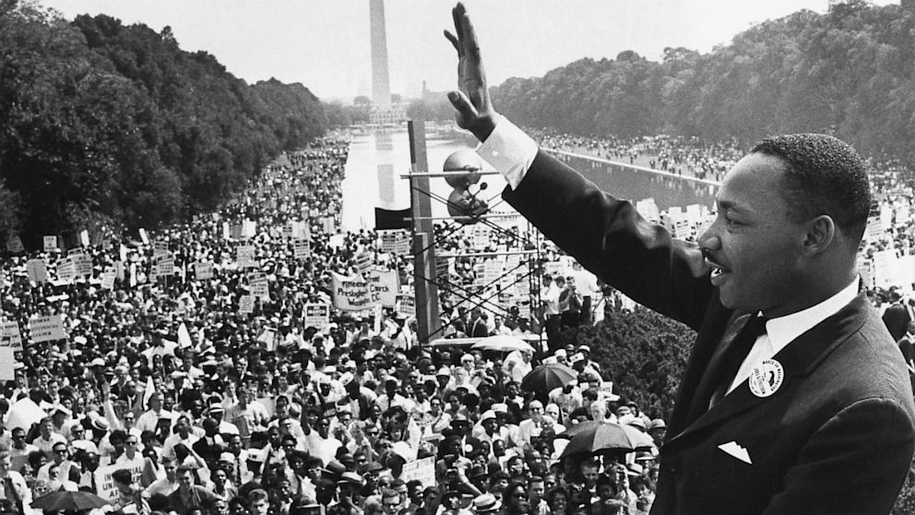
Today, our nation honors the legacy of Dr. Martin Luther King, Jr., who through his faith forever transformed our nation from a society of systemic racism and segregation to a nation that aspires to live up to its founding principles.

It would be naive to say that we live in a post-racial America, and I believe that there is still much to be done to achieve the racial healing and reconciliation of which Dr. King dreamed.

However, it would be self-defeating to fail to recognize the progress that has been made, and the cause of that progress.

Dr. King was motivated by a dream, a dream built on the foundations of his core convictions, which were born of his faith.

That faith was in the God almighty, and our Lord and Savior Jesus Christ. To deny this is to deny the sermons Dr. King preached at Dexter Avenue Baptist Church, or his belief in the power of Agape love to not only bring about racial equality, but reconciliation as well.

To deny Dr. King’s faith as his motivation is to deny an entire paragraph of his “I Have A Dream” speech, which states, “This is our hope. This is the faith that I go back to the South with.

“With this faith, we will be able to hew out of the mountain of despair a stone of hope. With this faith we will be able to transform the jangling discords of our nation into a beautiful symphony of brotherhood.

“With this faith we will be able to work together, to pray together, to struggle together, to go to jail together, to stand up for freedom together, knowing that we will be free one day.”

To deny the faith of Dr. King and to deny the scriptures as the source of that faith is to deny the Biblical imagery that defined his speeches, whether the carving of the stone of hope from the mountain of despair, to the mountaintop Dr. King said the Lord took him to, allowing him to see the promised land.

To deny the faith of Dr. King is to deny his optimism, fully communicated in his speeches, which came from his belief that God would bring his dream to fruition, even if not fully realized until the coming of the Lord.

Dr. King’s legacy of racial equality, national repentance, and racial reconciliation cannot be denied. Neither can the faith be denied which moved him to lead this national transformation. Faith in the Lord brings amazingly great things.

Hebrews 11:33 says, “Who through faith subdued kingdoms, wrought righteousness, obtained promises, and stopped the mouths of lions.” Hebrews 2:20 says that faith without works is dead. In other words, faith motivates action, and when faith motivates action, great changes happen.

As we remember and celebrate the accomplishments of Dr. King, and the transformation he led America through, let us not forget the faith that birthed it all.

Furthermore, let’s remember that the next great advancement in our society, whatever it may be, will not be born from a desire for significance, a desire for change, or a change at the ballot box. The next great advancement will come when the people of God act on their faith and carry God’s amazing message to the people.

With this faith… we advance.

I’m Dying: What I Learned from My Diabetic Diagnosis

“It’s probably no big deal,” my doctor told me. “Any blood sugar reading below 100 means you’re okay. 100-125 means you’re pre-diabetic, and above 125 means you’re diabetic.”

The reading came back on the monitor… 200.

“Okay, so you’re a diabetic. Here’s what we’re gonna do…”

The following words were a series of prescriptions the doctor would recommend, the recommendation for exercise (run 30 minutes per day, four times per week) and a dietary recommendation (no simple sugars).

I wish I could say that this all came as a shock. It didn’t. I wish I could say I am just a victim of circumstance, the recipient of bad DNA. I can’t. I wish I could claim I wasn’t warned. I was.

Two years prior, I sat in the same doctors office after having a life insurance application denied due to a high A1C. Back then, we tested, and I came out okay. Diet and exercise would save the day. I started out well, but I didn’t finish.

Ten years prior to that, I registered a high blood sugar during a visit with the same doctor. I corrected my diet then, returned for a follow up, and was fine.

The doctor warned me that this day was coming. I was told to eliminate fried foods, not to drink my calories (sodas), and to exercise. After each warning, I would start out well, but after a couple of months, the disruptions would get to me, and I’d fall off my program.

A headline involving dying and diabetes may sound melodramatic, but it’s not. This is a terminal illness, but it’s one that can be managed. Diabetes is a disease where your body no longer breaks down the blood sugar. The result is a thickened blood that fails to reach the capillaries, resulting in organ damage. Also, the sugar itself damages tissues within the body.

Diabetics suffer from nerve damage, vision loss, and ultimately heart attacks and strokes, if not managed properly. Once the damage is done, it does not heal. Lost vision does not get restored. Damaged nerve endings never regain function.

My doctor and I have a plan, and I am confident in his ability to help me manage this diagnosis, but receiving this diagnosis has taught me a few things.

  1. The day of reckoning is coming. For so many of us, we know that the consequences of our actions are coming, but we deceive ourselves into thinking that the consequences are far away, and we will be better able to manage those consequences when they finally arrive. This is one of the biggest lies we tell ourselves. Whether we think we are delaying the consequences of poor health choices, or delaying the consequences of our spiritual choices, we tend to put off making the decisions that we need to make. However, the day is coming, and it will come as a thief in the night, at a time when we least expect it.
  2. We must make the right choices today. As I just mentioned, the day of reckoning, when we will receive the full consequences of our choices is upon us, and it is coming faster than we think. We can no longer afford to say, “I’ll start that diet tomorrow,” or “I’ll open that retirement account next month,” or “I’ll start going to church and get right with Jesus next week.” We must make those decisions today. First, we don’t know that we have tomorrow, next week or next month. Our day may creep up on us sooner than we think. Secondly, the sooner we make those choices, the more beneficial they will be for us.
  3. To follow those choices, we must learn to manage the disruptions in life. When my doctor asked me why I hadn’t been able to get my diet in order, I told him about the upheaval in my family, last year’s COVID outbreak at church, career issues, and the ongoing turmoil that I have found to be life. I told him, “I just did not do a good job of managing the disruptions in my life.” We can no longer afford to use those disruptions as excuses, because disruptions are part of every day life. As Agent K said in Men In Black, “There’s always an Achillian Battlecruiser or an intergalactic plague about to wipe out our planet. The only way these people get on with their lives is that they do not know about it.” Over the past few years, we’ve seen economic and political disruptions, and our entire society shut down by a global pandemic. This is the new normal, and such disruptions will continue, in addition to your personal disruptions. We have to learn to manage these disruptions and move forward.
  4. What was death to me has now become life. Prior to my diagnosis, the idea of being fit sounded good, but I was happy being chubby and lazy. Sure, healthy food will make me feel better, and there’s nothing like the rush of finishing an ultra-marathon, but have you ever enjoyed a bowl of Blue Bell Ice Cream and a Netflix movie on an overcast Saturday afternoon? I chose the latter. It was easier, simpler, and more delicious. However, with my diagnosis, I now see that health foods and medications are not a way to a better life, they are the only way to seize and maintain life. With each salad, vegetable, and lean grilled meat, I am extending my life, and with each medication, I am helping my body restore its function. Over the past few decades, churches have sought to sell potential converts on the benefits of Christianity by saying that it leads to a better life. It does. But Christianity is life. Faith in Jesus is the only way to avoid eternal damnation. And just like my diabetic diagnosis came suddenly (but with warning), our last day of life and the day of judgment will come upon us suddenly. Don’t get shocked by a negative test result that day. Turn from your sin and trust Jesus as your Savior.

The diabetic diagnosis can be a life sentence or a death sentence. My doctor told me that in those exact words. And with God’s help, I will manage this disease and live to serve Him well in my life. However, this whole experience has taught me that I need to wake up, and start taking care of what matters, regardless of how I feel. I can no longer make excuses, I can no longer procrastinate. And the same goes for you.

If you have been putting off the decision to turn your life over to Christ, make that decision today. And if you have been putting off your health and financial decisions, you will avoid catastrophes and reap better benefits if you make those choices today. Don’t follow in my footsteps. You have the opportunity to do better.

May God bless you.