
It was Saturday afternoon, sometime in late 1997. I sat in a booth at the Pizza Hut in Jacksonville, Texas, waiting for my personal pepperoni pan pizza.
They brought that delicacy out in a piping hot iron pan and served it to you right there on your table, pan and all. I was already sipping on my soda, served in one of Pizza Hut’s iconic red plastic cups.
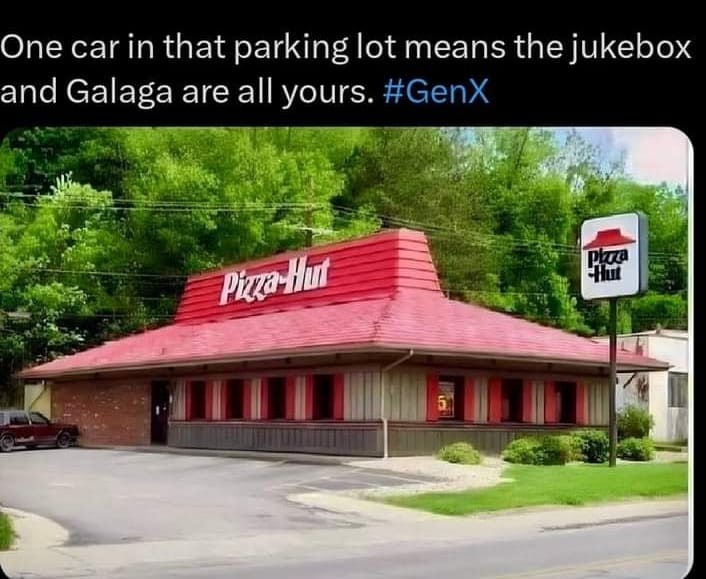
The jukebox was jamming out to an old AC/DC song and I was looking forward to a big night at my best friend, Ronnie’s, house. We were going to, once again, attempt to conquer “Tomb Raider” on the first-generation PlayStation system. If Ronnie ever beat that game, I wasn’t there for it.
Sunday night would see my return to college at Stephen F. Austin State University, where I would wake up at 9 a.m. on Monday just in time to make it to my 10 a.m. broadcasting class before going to lunch at East Cafeteria, where I would be treated to all-u-can-eat flame broiled hamburgers, and “Silver Springs” by Fleetwood Mac playing on the jukebox.
Fleetwood Mac… in a few months, I would be able to attend their tour, “The Dance,” at the Coca Cola Starplex in east Dallas. That show was perfectly choreographed, with every move, note and song matching Fleetwood’s PBS special that aired earlier that year. The only thing missing was the USC Marching Band. Not a bad show for $10.
No bills. Inexpensive entertainment. And disposable income. No worries, just how to entertain myself next. Life at the age of 19… as it should be.
Life was good. Those were the “good ole days.”
In 2016, Donald Trump ran for his first term in office under the slogan, “Make America Great Again.” At the time, I was co-hosting a talk radio show with my good friend, Brian Wade. We theorized that, if Donald Trump wanted to “make America great again,” then there must be a time in American history that he was looking back on which he perceived America to be greater than it is today.
So, we went on the air and asked our audience to call in. Tell us, “When was America greater than it is now?”
Our audience gave different answers, ranging from the 1950s to the 1990s. What we found was that most people saw America at its greatest around the time they turned 18… when the benefits of earning money and starting their lives were first being realized, but before the realities and burdens of adult life set in.
For most, America was at its finest, not when the markets rallied or the wars were won, but when their lives were good. One man even said America was at its best in the late 1970s. The voters in the 1980 election beg to differ, but in the late 70s, this man had a good job, a good home, and a good family.
The good ole days.

What I didn’t realize in August of 2016, as Brian and I were creating the best radio that Brownwood, Texas, has ever heard, was that in a few short months, Brian would be called home to Heaven after suffering a pulmonary issue.
We never really know where we are standing, how good the time is, and how fleeting that moment truly is.
Adam and Eve stood in the garden of Eden… a perfect life, everything they could want, no problems. But… they didn’t realize where they were standing, how good things were, and how that paradise would be lost once they rebelled against God.
I wonder if Adam and Eve ever felt nostalgic for the Garden, the way we often feel nostalgic for our lost youth?
Nostalgia…
Nostalgia is an English word that descends from two ancient Greek words, Nostos (homecoming) and algos (pain.) It’s a sentimental longing for a period in the past, often accompanied by the pain of grief over the innocence and youth lost, the time past, and friends and family who have passed on.

What does scripture say about nostalgia?
Very little.
Ecclesiastes 7:10 warns us, “Say not thou, What is the cause that the former days were better than these? for thou dost not enquire wisely concerning this.” That the ongoing longing for times that seem better than now is not wise.
Philippians 3:13-14 tell us “Brethren, I count not myself to have apprehended: but this one thing I do, forgetting those things which are behind, and reaching forth unto those things which are before, 14 I press toward the mark for the prize of the high calling of God in Christ Jesus.”
In both verses, we are warned against living in the past, but that doesn’t mean that it’s a sin to remember the past. Rather, when we remember the past, we do so with purpose, remembering God’s goodness, blessings and mercy, while at the same time looking forward to what He will do next.
So, to help us with this, let’s keep a few things in mind.
First, realize that when we look back on memories, we tend to look back with rose-colored glasses. Truth be told, the good ole days weren’t always that good.
Sure, America was prospering in the post-war years of the 1950s, but we faced a polio epidemic and the threat of nuclear annihilation at the hands of the Russians.
The 1960s might have been fun, but that’s only if you forget the near collapse of the American government and economy in the aftermath of the Kennedy assassination and the dark forces that were truly driving the counter-cultural revolution.
The 1970s may have had good movies and music, but stagflation wiped out the income of American workers and there were gas shortages.
The 1980s brought us AIDS. The 1990s brought us scandal, divisive politics and the beginnings of global terror.
I mean, Billy Joel has a hit song from the 1980s about all the challenges that post-war America faced.
Secondly, realize that today isn’t all bad. Yes, the simplicity of last century is gone, and the world we grew up in will never return. However, from the 1950s through the 1990s, generations back then grieved the changes that were taking place. Yet, today, we look back on those years as the good ole days, remembering some really good things about the times we complained about back then.
Everything is different now, and there are a lot of anxieties to daily life now. Cell phones and remote work has isolated us. Entire communities are disappearing even though the houses and people remain.
Yet, good things are happening today.
On a Spiritual level, I don’t think I have ever seen a younger generation so inquisitive and accepting of Biblical truth as the young Gen-Z, and Gen-Alpha. While social media shows the extreme left-wing and atheistic wing of those generations, in real life, there are multitudes of young people who are not only open to the Gospel, but crave a deeper understanding of the scriptures.
They seek what’s real. And, we as Christians and churches have the opportunity to cultivate that curiosity and foster that growth in faith in these younger generations that could spark a revival such as we have not seen since the 1950s.
Furthermore, if we take stock of our own lives, and take the time to count the blessings God has given us, we will find that, national and global issues notwithstanding, life is still good.
And finally, it will help if we remember that there is still purpose to life. If you opened your eyes this morning, God still has a purpose for your life. If you are still breathing, God is still working with you.
Sometimes, we go through seasons where we feel that we no longer have a reason to live. There’s no more purpose to life.
This is very common for empty nesters whose children have just moved out of the home. This is also common for retirees who have no idea what to do now that there’s no longer a career to wake up to.
It may take some time, but God will lead you to your purpose. Take this time to rest and to get into His word, and gain more understanding of him. Also, take a road trip, or go fishing. Enjoy life.
And as you enjoy it, just know that there is still purpose to life.
As we follow these steps, we will find ourselves less bereaved over the passing of the good ole days, and more purpose-driven, making these current days the good ole days. As we do that, we may even see the Kingdom of God advance.
May God bless you richly today.
 Leland Acker