
Tag: Gospel

Am I a One-Trick Pony?

Photo by Barbara Olsen on Pexels.com

If you drove through Lisbon Falls, Maine, about 10 or more years ago, you may have found yourself stopping by the Kennebec Fruit Company, a corner store owned by Frank Anicetti, a local legend who was made famous nationally by Stephen King’s, 11/22/63. Anicetti passed away in 2017.

If you go to Lisbon Falls today, Anicetti has been memorialized through the renovation of his store, now a restaurant called “Frank’s Restaurant and Pub.” Stop in and visit with the locals, and they’ll tell you about a man who had one thing on his mind… Moxie soda.

Anicetti was a big fan of the drink, served it in his store, believed that the world was full of two types of people (those who liked Moxie, and everyone else), and always encouraged any new visitor to try the beverage.
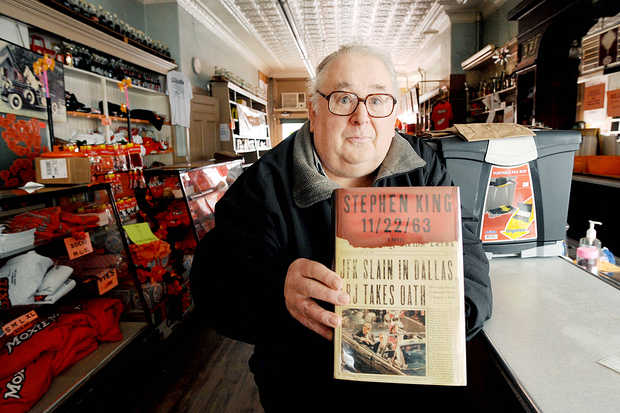
Frank Anicetti, an enthusiastic fan of Moxie soda, relished being depicted in Stephen King’s 11/22/63.

Moxie was one of the first national beverages to be successfully marketed in New England, and it provided Anicetti with a great amount of nostalgic joy. Anicetti is a big part of the reason why, every year, Lisbon Falls hosts the “Moxie Festival.”

If everyone has one gift they give to society, Anicetti’s was Moxie soda. His love for the drink and his enthusiasm for its support were captured when Stephen King included him as a minor character in 11/22/63, a novel about a man from Lisbon Falls who goes back in time to prevent the assassination of John F. Kennedy.

We call people like Frank Anicetti a “one-trick pony.” Well, not really. We like Frank, and found his obsession with a mediocre beverage to be endearing. Usually when we call someone a “one-trick pony,” it’s not a compliment.

Frank Anicetti’s Kennebec Fruit Company, proud seller of Moxie soda, prior to 2017. Anicetti passed in 2017, and the store has been renovated and re-opened as a restaurant. The green paint is gone, and the store is now trimmed in Moxie orange.

It’s something we call people who have a high-level of expertise in one thing, and are useful for little else.

Which brings me to my question… “Am I a one-trick pony?”

If you’ve listened to me preach, or really have had any sort of theological discussion with me, you may have noticed (or at least I hope you’ve noticed) that I always bring the discussion back to the Gospel.

The Gospel, of course, is defined in 1 Corinthians 15:3-4 as how Jesus “died for our sins, according to the scriptures, was buried, and rose again the third day according to the scriptures.”

I believe that the Gospel is the central message of the Bible, and that every passage is either declaring the Gospel, illustrating the Gospel, points to the Gospel, or is recording events that set up the Gospel.

I believe the Gospel is the power of God unto salvation, that by placing one’s faith in the Gospel one is saved, and that every true Christian doctrine stems from the Gospel.

For example, I believe that marriage is to be a picture of the Gospel. The relationship between a husband and a wife should be an illustration of the relationship between Christ and His people.

I believe that Christian parenting should reflect the relationship between God and His children.

I believe that doctrines on giving, forgiveness, grace, and mercy, all are rooted in the Gospel.

I believe that Biblical teaching on how to conduct business and how to manage relationships should be rooted in the Gospel.

I believe this, not only because it’s true, but also because if you remove the Gospel from any Christian teaching, you will wind up with a legalistic system which will breed Pharisaism. We’ll become like the Sanhedrin of Jesus’ day.

Furthermore, if you remove the Gospel from Christian teaching, our religion becomes hard-hearted very quickly.

Therefore, I aspire to be like Charles Spurgeon, who famously said, “I take my text, and make a bee-line to the cross.”

Christianity is a religion of forgiveness, redemption, reconciliation and restoration. All of this is possible only because of the Gospel. When we lose the Gospel, we lose forgiveness, redemption, reconciliation and restoration. And when we lose those things, we lose hope.

So, if being obsessed with the Gospel makes me a one-trick pony, I’ll gladly wear that label, then I will retire to my living room with a freshly opened bottle of ice-cold Moxie soda. (Or, since they don’t have that in West Texas, I’ll settle for Diet Coke.)

May God bless you as you walk with Him today.

Why the Gospel is Key

What is the point to Christianity? What is the central belief of the Christian faith?

I fear that for the most part, we’ve gotten so involved in preaching the Christian lifestyle and participation in faith communities that we have forgotten what it is truly all about.

In 1 Corinthians 15:3-4, Paul defines the Gospel as how Jesus Christ died for our sins, according to the scripture, was buried, and rose again the third day according to the scriptures.

The Gospel, the central message and belief of our faith, is that the Lord Jesus Christ became man, lived a sinless human existence, before going to the cross to bear the wrath of God for the sins of all mankind. Then, He rose again to defeat death and to give us all eternal life.

This is not only key to our faith and belief system, but it is absolutely necessary for us to have hope for life beyond this life, because faith in the Gospel is absolutely necessary to have our sins forgiven and to be given salvation and eternal life.

In the above posted message, we discuss the universal need for the Gospel.

The Jesus Revolution

The more things change, the more they stay the same. Seriously, listen to any Billy Graham sermon from the 1970s, or any J. Vernon McGee sermon from the 1960s, and you will find the same issues being addressed from the pulpit.

The breakdown of the family, the rise in sin and immorality, an up and coming generation that seems unreachable, with a lifestyle and value system that seems incomprehensible, a deeply divided country, civil unrest, economic uncertainty, and foreign threats… these are all issues that plagued our country back then, and they are issues that haunt us now.

The upcoming film, Jesus Revolution, depicts how the ministries of Chuck Smith and Greg Laurie were revolutionized by the introduction of Lonnie Frisbee. Smith is depicted as struggling to establish Calvary Chapel in California as a Biblical-centered congregation, who struggles to understand the hippie movement of the 1960s. Smith then meets Frisbee, who encourages him to engage the marginalized youth and preach the Gospel to them.

History records what followed as The Jesus Movement, recorded by Greg Laurie in his book Jesus Revolution. There was a revival among the Hippie communities of California, which sparked a new wave of evangelism and worship music. The result was countless converts, the rise of Calvary Chapel as we know it today, and contemporary Christian worship music.

Jesus Revolution is a film based on a true story, it is not a documentary. How the film will tackle the controversies surrounding Smith’s ministry, Calvary Chapel, and Frisbee’s issues with sin have yet to be seen. All are worthy of discussion as we come to a fuller understanding of God’s grace and redemption.

However, the theme of the movie appears to be how the Gospel of Jesus Christ is exactly what our dark and deeply divided nation needs to hear, and if we are willing to reach out to those whom we fear or don’t understand with the Gospel, souls will be saved and lives will be changed.

In essence, if the church of God will re-center itself on the Gospel and return to the mission of God, which is the preaching of that Gospel throughout the world, who knows what kind of revival we may see in our day.

Like our forerunners in the 1960s, we face a rise in sin and immorality, a rise in Godlessness, a rise in darkness and division, with an up and coming generation with a lifestyle and values system that scares the very generation that brought us the hippie movement.

Our options are simple. We can, like Kelsey Grammer’s depiction of Chuck Smith early in the film, sit back on our couches and complain about the direction of society. Or, we can, like Jonathan Roumie’s depiction of Lonnie Frisbee, reach out into that darkness with the light of the Gospel and show a lost generation that God’s door is open to those who repent and believe.

My prayer is that we do the latter, which is why I am excited about this film. I hope it inspires our current generation of churches, and a new generation of churches to truly commit to, and do, the Great Commission.

Yes, Virginia, You Can Go to Therapy

Photo by cottonbro studio on Pexels.com

Progressive pastors never miss an opportunity to enrage the fundamentalists, and the fundamentalists never miss the opportunity to be enraged. Such was the case recently on Twitter when a progressive pastor of whom I have never heard posted a tweet encouraging people to attend churches where the pastor goes to therapy, and encourages the congregation to go to therapy. The result? An onslaught of fundamentalists decrying this pastor’s statement, saying in essence, “all you need for mental health is the Bible.”

I’m going to be real about this. If I were to ever find myself in a position where I needed therapy, I would probably remove myself from the pulpit. I would feel that I would not be fit for Spiritual leadership, and that the church deserved better. But that’s an expectation I place on myself.

As for therapy and the Bible, let’s begin by setting the stage by defining what the Bible is and what the Bible teaches.

First, the Bible is the inspired word of God, penned by prophets and apostles who had God’s word given to them either through vision, angelic message or by direct dictation by God Himself. You can see the inspirational process in action when you read Revelation. The Apostle John, banished to the Isle of Patmos, saw the resurrected, glorified Jesus. Jesus then told John what to write. Throughout the book of Revelation, John sees things and tries to describe them. Angels tell him what to write, and at times, the Lord dictates to Him as well. However, the entire thing came from God, and thus is God’s word.

The Bible, being God’s word, is all we need for faith and practice. It’s all we need to learn more about God, to build our faith, and to live our lives in accordance with that faith. However, to say that all we do is drawn from scripture is an error. Not all church traditions come from scripture, neither are all of our personal choices.

Scripture did not teach the church to open the worship service with Doxology, recite a creed, do a responsive reading, sing three hymns, collect an offering and receive a sermon from the professionally paid pastor. There are a lot of beautiful traditions in the church that I believe praise and honor God, but many of these traditions are not explicitly laid out in scripture. Some point to certain passages and say that it can be inferred that these traditions were in place among the apostles, but that is a mighty big assumption to make.

Since we find that, in the church, we can make decisions and do things that scripture did not specifically teach, but still honor God in so doing, it follows we can do the same thing with our personal lives. Scripture says very little about how to pick a career, how to choose a college, or whether to send your kids to public school or private school. Scripture does teach us how to work (do all for the glory of God), but it does not tell us how to go about choosing what kind of work to do. The lesson is that you can still honor God by making these choices.

Does that mean that scripture lacks direction for believers? As Paul would say, “No, in no wise!”

Scripture was not given to teach us how to do church, how to live life, how to make money, etc. Scripture was given to teach us how to have a right relationship with God. And that right relationship comes through two steps, (1) learning, understanding and accepting the Gospel as truth, and (2) repentance and faith.

The central message of the Bible is the Gospel. All scripture either sets up the Gospel, illustrates the Gospel, explains the Gospel, or declares the Gospel. The Gospel is defined in 1 Corinthians 15:3-4, “how that Christ died for our sins according to the scriptures, that He was buried, and that He rose again the third day according to the scriptures.”

Jesus Christ died for our sins, meaning that His death on the cross satisfied the judgment and wrath of God for man’s sin, thus we can walk away scot-free from His judgment, if we believe. Christ took that wrath upon Himself and shielded us from it. The fact that He rose again proves his power and victory over death. By defeating death, He brought in eternal life, so we can have the confident expectation (hope) that we will be received into His Kingdom (Heaven) when we die.

The Gospel teaches that I am broken, that I am a sinner, that my rebellious and selfish choices have inflicted harm upon myself, and those around me. However, through the Gospel, Jesus can heal my broken spirit, wash away my sin, and restore me and those around me from the harm I’ve caused.

Since many mental health issues stem from the issues of sin and brokenness, it is entirely possible, and very common to find healing in the Gospel and the Gospel alone. As a pastor, I counsel individuals through this process. I can, using only the Bible, show the source of the pain an individual is in, show how comfort and healing can be found in the Gospel, and give my congregant hope. I can, from the scriptures, demonstrate God’s divine purpose in suffering, and in so doing provide comfort for the one seeking my help.

And while I have seen people healed through this ministry multiple times, I can also say that there is a time when one needs to seek a qualified therapist who believes the Bible. I say this because I can demonstrate everything I have listed, but I cannot teach someone how to identify and control triggers.

In the Bible, I can show hope, but I cannot manage a chemical imbalance, or the brain patterns of someone whose mind has been altered by repeated mental, emotional and physical trauma.

In the Bible, I can listen and be non-judgmental, but sometimes people want to talk to a stranger for another view, another set of eyes and expertise.

And that is okay. I have on a couple of occasions referred people to qualified counselors who hold a Biblical worldview. And those folks got the help they need.

So, if you’re having issues, let’s talk. If I cannot help you, or you need more intense therapy, let’s get you to a counselor.

So, yes, Virginia, you can go to therapy.