Tag: Faith

What’s the deal with the “He Gets Us” campaign?

Like running into an old friend at the supermarket, I was delighted to see that the “He Gets Us” campaign ran another commercial during this year’s Super Bowl.

You wouldn’t think the campaign would continue to stir controversy, but it does. Sometimes, the mere existence of something can ruffle feathers.

When the “He Gets Us” campaign ran its first Super Bowl commercial two years ago, the controversy stemmed mostly from atheistic and anti-Christian groups prior to the Super Bowl. Their concern was that a game that celebrates achievement, pride, gluttony and pleasure would be ruined by a religious message.

That they got was this ad instead:

Something interesting happened after that. The dissenting voices of atheism and the anti-Christian communities died down, and voices of opposition rose from within Christianity itself.

The campaign was ridiculed for departing from mainstream Christianity, with many claiming it was theologically shallow and didn’t proclaim any real truth from the Bible.

Then, He Gets Us rattled the cages again in 2024 with this message:

The message that provoked response in this ad was the depictions of Christians, preachers, and the so-called good people of the world washing the feet of people who are living in sin. You see the feet of pro-abortion activists being washed outside an abortion clinic, of illegal immigrants feet being washed, while at the same time foot washings being shared between people of different races and people who obviously would be at odds with each other.

The commercial closed out with the caption that Jesus didn’t teach hate, He washed feet. This ad drew criticism, with opponents saying that Jesus did not merely go around washing feet, but that the foot-washing was performed on His disciples to teach them humility.

This discussion brought to light the central point of conflict between the He Gets Us campaign (funded heavily by Hobby Lobby owner David Green) and Christian fundamentalists. That point of conflict is this: The He Gets Us campaign lacks theological depth, drifts from what the Bible actually says about Jesus, and fails to present the plan of salvation.

If we’re being honest, those criticisms are not without merit. The question is, however, does that make the He Gets Us campaign bad?

Let’s consider that question with this story in mind.

Imagine there is a lady in your church. Let’s give her a name. She’s going to be Miss Martha.

Miss Martha is an 80-year-old widow who attends church faithfully, serves in the ladies auxiliary, and has a special pecan pie recipe that has become a staple of the church potluck dinners.

After church last Sunday, Miss Martha went to lunch at the local Kentucky Fried Chicken. As she ordered her food and paid, she noticed the unmistakable presence of a baby bump in her cashier’s abdomen.

Miss Martha asked when she was due, and how much she looked forward being a mother. The conversation was friendly, and Miss Martha learned a little about her new cashier friend.

Miss Martha then told the young woman, “I know you have to work a lot of Sundays, but if you get the chance, we’d love to have you at church next Sunday.”

Maybe Miss Martha invited the young woman to evening service, or Wednesday night prayer meeting. All would be typical in such a conversation.

Now, the question about Miss Martha’s interaction with the KFC cashier is this, “Did Miss Martha do a bad thing by holding the conversation with the young woman, inviting her to church, without presenting the Gospel to her or having a deeper Biblical discussion with her?”

Some would say yes. I think Ray Comfort may have some words to say about that.

However, I disagree.

It’s never a bad thing to have a conversation with someone, to express to someone that they have value and are loved, to issue an invitation to church, and to create an opportunity for someone to consider their faith and Spiritual condition. I believe if we actually took an interest in people, got to know them, and connected with them in an authentic way that was not merely for the purpose of notching a conversion on our belt, I think we may see some better results.

The mission of the commercial campaign for “He Gets Us” is not to place Gospel-centered content in a secular entertainment setting. (That’s actually something I aspire to.)

The purpose of the He Gets Us campaign is to snag the attention of those who are lost and are not considering Spiritual things, and get them thinking. It’s about presenting a side of Christianity that recognizes the brokenness of life, the differences in our backgrounds, and our propensity for conflict, but wants to work through that to find healing.

And while I whole-heartedly agree that the Gospel is absolutely essential to accomplishing that goal, and that deeper theological discussions must take place to bring salvation and transformation into the lives of the lost, I would be remiss if I didn’t relay the fact that the He Gets Us campaign does exactly that.

Take Miss Martha for instance. Suppose she comes back to KFC next week, meets the same cashier, has another light-hearted, pleasant conversation with her, and learns more about her. Maybe this continues for a few weeks. Maybe the baby is born, and the young cashier shows Miss Martha pictures.

Suppose Miss Martha takes the young woman one of her popular pecan pies, and maybe they meet outside of KFC for once. Maybe Miss Martha mentors the young woman, and ultimately takes her to church one day. What could happen?

Hopefully, if Miss Martha goes to a good church, that young woman will hear the Gospel, solid Bible teaching, and be saved and converted.

The He Gets Us campaign works the same way. It seeks to engage people who are not engaged Spiritually, ascribing value to them and proclaiming that they are loved. At the end of every commercial and YouTube video, there is a Web address. If you go to that Web address, you will find Bible teaching and content that steers you toward the Gospel. And, while you may not find that content to be deep enough or theological enough, it does provide the opportunity to connect with a Bible mentor, or counselor, via text, phone or email.

And here’s the best part. These mentors are not located in a call center in Oklahoma. They are in your hometown.

It’s true. Local pastors and Bible teachers can register with the site, and if someone from their area is wanting to be connected with a real person, He Gets Us connects the pastor with the seeker, thereby facilitating the teaching of the Gospel and deeper Bible content. Discipleship can then begin at that point, and the seeker can be connected and plugged in to a local church.

Is this the most economical way to do this? Is it efficient? Does it work?

I don’t know. I will say, having read two of David Green’s books, he doesn’t have much patience for things that do not work. To answer that question, we’d have to see the ledgers and the data that He Gets Us would keep concerning their reach and conversions. I’m not holding my breath that they’re going to make that public any time soon.

I will say, that having a business and marketing background, I can see how it would all come down to numbers.

One Super Bowl ad will cost about $7 million. That ad will reach about 125 million viewers. The cost per thousand on that one ad is $56. This is almost twice the cost of a Roku ad, which typically sells for $30 per 1,000 viewers, and almost six times the cost of a radio ad, which usually runs about $10 per 1,000 listeners. It’s expensive, but there’s added value in the fact that you are reaching the multitude simultaneously, something nearly impossible in other media.

Now, let’s suppose that only 1/2 of a percent actually go to the website. That’s 625,000 visitors to the He Gets Us website. If only 1/2 of a percent reach out to a local pastor, that’s 3,125 solid Gospel conversations that can take place. If only 1/3 of those result in a profession of faith, you have approximately 1,000 souls saved, on a $7 million investment made from the excesses of billionaire businessmen.

We don’t put a dollar figure on the cost of seeing a soul saved. But, if we calculated the amount spent per soul saved, it would come out to $7,000.

I realize this type of analysis may be a little provocative. I don’t intend to be provocative. But, I will say that many of my church’s outreach efforts were not near as fiscally efficient as that.

None of this means that you have to like the He Gets Us campaign, and it certainly does not mean that this is the best way to do evangelism. However, I hope this adds understanding of what is happening and puts some context on the commercials you see on TV.

Furthermore, I hope this motivates you and inspires you to find ways you can engage people in your community who are not currently being engaged with the Gospel.

May God bless you as you serve Him.

I’m adding the Be Childlike ad because I like it:
Breaking down the #HeGetsUs campaign

Easily the most talked about, and most controversial commercial during the Super Bowl was a product of the #HeGetUs campaign. The marquee ad, entitled, “Love Your Enemies,” ran during the second half, as all the parties would have settled into the game and begun contemplating who would emerge as winner.

As you can see above, the ad featured 60 seconds of photos of conflict underlied by a soulful bluesy song by John “The Ragin’ Cajun” Jones called “I’m Only Human After All.”

The most controversial aspects of the ad are hard to determine. The fact that an organization is running ads to promote Jesus proved to be in and of itself controversial, as pundits across the spectrum questioned whether Jesus would have bought a Super Bowl ad, and whether the money could’ve been better spent feeding the poor.

While the Bible teaches mercy and benevolence toward the poor, those who have actually read the Bible know that in the New Testament, Jesus set the spread of the Gospel and the making of disciples as the top priority for the churches.

Such criticisms have even led many to call for taxing churches. However, the funds for the ads did not come from churches, but rather came from David Green, founder of Hobby Lobby, who literally made his fortune selling beads to hippies and soccer moms, and who gives half of the profits of Hobby Lobby away every year to organizations who spread the Gospel and provide relief to those in need.

Would Jesus buy a Super Bowl ad? I don’t know. But I do know that He would be pleased His name was proclaimed to millions without the neglect for the poor.

The second point of controversy was the confrontational aspect of the ad. The images of protest and conflict conjured up emotions of rage toward those on opposite sides of the political spectrum from us, then the message blindsided us with “Jesus loved those we hate.”

This message refers back to the words of Christ spoken during the Sermon on the Mount, and echoed by Dr. Martin Luther King, that we are to love our enemies. Love your opponents, and those who work against you.

The objective in loving our enemies is twofold, (1) To identify ourselves as God’s people and (2) to see our enemies redeemed.

This concept goes against our human nature, so we find it offensive. Yet, it’s not only Biblical, it was mandated by the Lord Himself, in the red letters, in the New Testament. There’s no getting around it. We are supposed to love our enemies.

Thus, there was an implied call to repentance in the ad. And that will always draw backlash.

Perhaps the final, and most controversial aspect of the ad was this… that Jesus loves those we hate. We have been conditioned to think that our enemies, our opponents, those different from us, are inherently evil and should be defeated and destroyed.

That is why our political discourse is as inciteful and incendiary as it is today. It’s not enough to defeat your opponent in a debate or in an election, you must also destroy his life so that evil can be vanquished and peace can permeate the world.

This mindset is wrong, because it’s false (opponents need to be won over, not destroyed) and based on a faulty premise. The wrath of man cannot bring the will of God, nor can it generate His peace.

However, when cable news, columnists and talk radio have convinced you that the other side is the embodiment of evil, the idea that Jesus could love them is startling.

Furthermore, if Jesus loves them like He loves me, then could He side with them also? Could Jesus possibly disagree with me?

And those questions drive the faith community, which easily drifts into self-righteousness, crazy.

A Jesus that disagrees with us is a Jesus that we still need to repent and turn toward, whose views we still need to conform ourselves to. And that means that it’s not just those we see as being lost that are being called to repentance, but it’s ourselves also.

That’s a confession too few of us are willing to make. Thus, the controversy surrounding this ad was near universal.

However, that doesn’t mean that the group behind the ad made a mistake. In his book, “Leadership Not By The Book,” David Green discusses the need to be disruptive, to shake things up and get people’s attention.

This ad was definitely disruptive. It broke our conventional thinking into what an evangelistic ad should look and feel like, and it broke cultural norms about who we perceive Christ to be. That forces us to either deny the Gospel, or re-center on who Christ really is and believe the true Gospel.

And because of that, I find the #HeGetsUs campaign to be hitting all the right points.

Who through Faith…

Why do we think of faith as an abstract? And why do we doubt the power of faith?

It makes no sense to downplay the importance of faith, nor does it make sense to doubt its power, not with so many tangible examples of how faith has changed our nation.

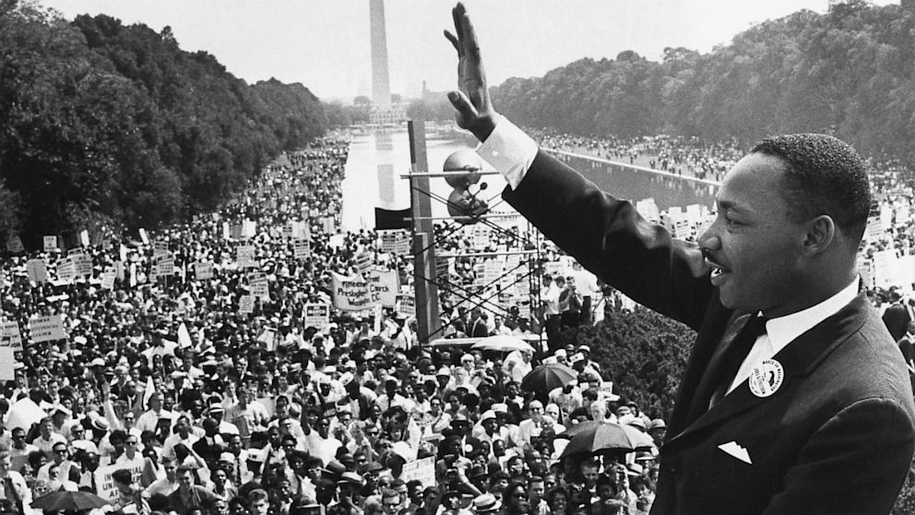
Today, our nation honors the legacy of Dr. Martin Luther King, Jr., who through his faith forever transformed our nation from a society of systemic racism and segregation to a nation that aspires to live up to its founding principles.

It would be naive to say that we live in a post-racial America, and I believe that there is still much to be done to achieve the racial healing and reconciliation of which Dr. King dreamed.

However, it would be self-defeating to fail to recognize the progress that has been made, and the cause of that progress.

Dr. King was motivated by a dream, a dream built on the foundations of his core convictions, which were born of his faith.

That faith was in the God almighty, and our Lord and Savior Jesus Christ. To deny this is to deny the sermons Dr. King preached at Dexter Avenue Baptist Church, or his belief in the power of Agape love to not only bring about racial equality, but reconciliation as well.

To deny Dr. King’s faith as his motivation is to deny an entire paragraph of his “I Have A Dream” speech, which states, “This is our hope. This is the faith that I go back to the South with.

“With this faith, we will be able to hew out of the mountain of despair a stone of hope. With this faith we will be able to transform the jangling discords of our nation into a beautiful symphony of brotherhood.

“With this faith we will be able to work together, to pray together, to struggle together, to go to jail together, to stand up for freedom together, knowing that we will be free one day.”

To deny the faith of Dr. King and to deny the scriptures as the source of that faith is to deny the Biblical imagery that defined his speeches, whether the carving of the stone of hope from the mountain of despair, to the mountaintop Dr. King said the Lord took him to, allowing him to see the promised land.

To deny the faith of Dr. King is to deny his optimism, fully communicated in his speeches, which came from his belief that God would bring his dream to fruition, even if not fully realized until the coming of the Lord.

Dr. King’s legacy of racial equality, national repentance, and racial reconciliation cannot be denied. Neither can the faith be denied which moved him to lead this national transformation. Faith in the Lord brings amazingly great things.

Hebrews 11:33 says, “Who through faith subdued kingdoms, wrought righteousness, obtained promises, and stopped the mouths of lions.” Hebrews 2:20 says that faith without works is dead. In other words, faith motivates action, and when faith motivates action, great changes happen.

As we remember and celebrate the accomplishments of Dr. King, and the transformation he led America through, let us not forget the faith that birthed it all.

Furthermore, let’s remember that the next great advancement in our society, whatever it may be, will not be born from a desire for significance, a desire for change, or a change at the ballot box. The next great advancement will come when the people of God act on their faith and carry God’s amazing message to the people.

With this faith… we advance.

I’m living! Here’s how…

Yesterday, I shared with you how I was recently diagnosed with diabetes, and the lessons I learned from the diagnosis. Today, I want to share hope, because the changes I made following the diagnosis are already working.

My diagnosis is nearly a month old. I may throw a little birthday party for it. LOL.

The day I received the diagnosis, I made changes. I consented to every medication the doctor wanted to prescribe, and I changed my diet. The McDonald’s drive-thru is dead to me, unfortunately, and I will no longer consume McNuggets. I had quit full-sugar sodas, but now I’ve almost completely eliminated diet sodas.

What do I drink? Lipton Diet Green Tea Citrus flavor… it’s good and doesn’t leave me feeling bloated.

My diet consists of Cobb Salads (when I’m in a rush, I can get one from Chick-Fil-A), Subway sandwiches, McAlister’s club sandwiches, grilled and sauteed meats, sauteed veggies, and dark rye bread. I have also been able to keep peanut butter in my diet, as well as salsa, and eggs. I often mix the salsa and eggs for my own form of huevos rancheros, which is good.

There’s an old joke where a doctor tells a diabetic to purchase a box of diabetic snacks, throw away the snacks, and eat the box. The idea is that healthy eating is bland and gritty. Nothing can be farther from the truth.

I’ve had to get creative, and I’ve had to rediscover my love for the kitchen and the grill, but utilizing fresh vegetables, fresh meats, low carb seasonings, almonds and cashews, I’ve been able to put together some recipes that I find delicious that I actually enjoy eating.

The second step is exercise. I am currently putting in at least 20 minutes on an elliptical each evening with the resistance level set to 4. My goal is to get to 30 minutes. Once I get to that, I will begin running.

How is all this working?

I haven’t tested my blood sugar. I need to purchase a device. However, my weight is down to 257, which means I’ve lost 20 pounds since the day of my diagnosis. And I feel great. My goal is to get down to 177 by the end of the year, and if I can keep my program going, I know I can make it.

The key is a change in my mentality. I am having to intentionally change the way I see food, the reasons I want food, and the way I evaluate a food’s quality. I have to see exercise as a pathway to life, and a fuller life. And, I have to be willing to trust my doctor, which I do.

There is also a spiritual component to this as well. What drove my bad eating and health habits up until now has been a spirit of depression and angst. I’m having to repent of that, and learn to deepen my relationship with the Lord. As my doctor said, “If you get your relationship right with God, all else falls into place.”

Angst, anxiety and depression are often (but not always) symptoms of a spiritual issue, where the individual’s relationship with God is strained by a lapse in faith. This is common and completely understandable. It’s understandable, as we can all understand why Peter took his eyes off of Jesus and saw the waves when he tried to walk on water, or why the disciples panicked when they were in a ship in the storm.

This is nothing to be ashamed of, but it is something to turn away from. God is in control of all things, and He intends good toward you. Trust that. As you trust Him, your relationship with Him will blossom, the negative feelings that drive our bad habits will subside, and we’ll find physical healing to match our spiritual healing.

May God bless you today.