Category: Literature

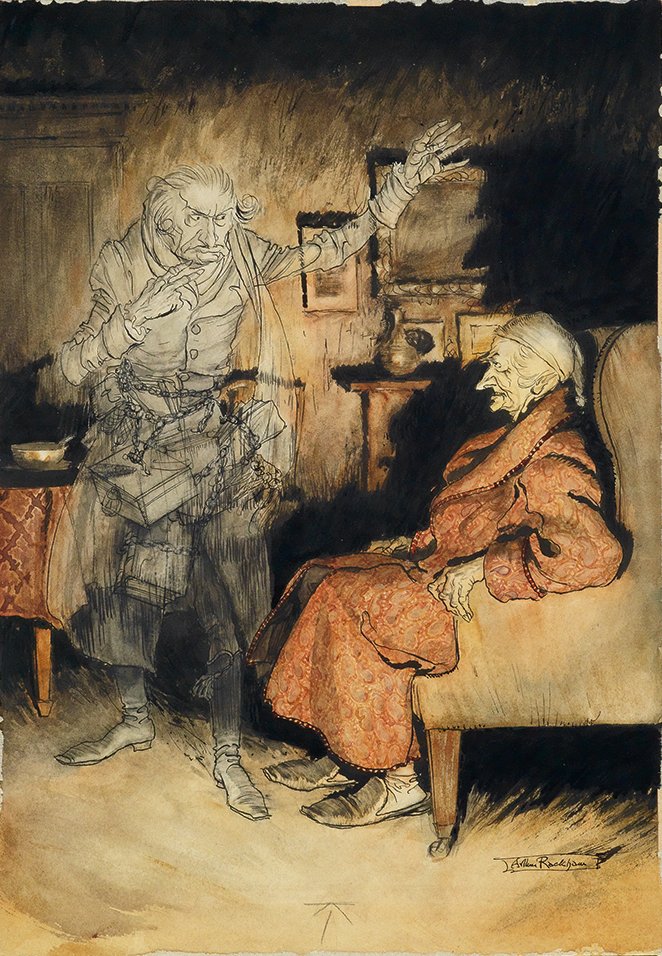
Jacob Marley’s Ghost… did you catch this?

As written works of literature become more familiar, we often lose the lessons the authors hide in the details. Whether you are discussing a familiar Bible story, or a piece of classic literature, the tendency is to drift toward the obvious story arc, and the moral thereof, missing the little nuggets and Easter eggs hidden along the way.

Such is the case with “A Christmas Carol,” by Charles Dickens.

So many of the details used in the story are often interpreted by the reader to simply paint the picture of who Ebenezer Scrooge was, and by extension who his late partner Jacob Marley was.

Scrooge was a heartless, bitter miser, no doubt formed by his meager, loveless upbringing and his pride in his own business dealings. Marley was like Scrooge, but being dead, was now condemned to an eternity of guilt, shame, and torment as a result of his sins against humanity.

The sins, by the way, were actually named in the book. Marley rejected any opportunity to help others, and thus was condemned to an eternity bound with chains, compiled by his many rejections of benevolence, and was doomed to watch helplessly as humanity suffered.

The other ghosts Scrooge was able to see during Marley’s visit suffered the same fate, with many giving futile efforts to help the living now that they had crossed into the afterlife.

Granted, none of this is scriptural, and Dickens wasn’t really trying to give us a Bible lesson, however, he was trying to give us a moral lesson.

Marley’s chains are often seen as the worst part of his condemnation, chains that were forged and linked by Marley’s own greed and disregard for others.

Those who read too fast, however, often miss what composed those chains.

Sure, the chains had your usual iron links that were looped together, but a major component of the chains were the cash boxes, bank books, deposit bags and ledgers that were connected.

Marley’s sin was driven by his love of money and his desire to be the shrewdest businessman in town.

As I was reading this, I began to think about the sins that would keep us out of Heaven, or the sins that could cost us in eternity. For many, there is a sin that is found so enjoyable that the sinner is reluctant to repent and turn to the Lord.

Thirty years ago, I drove across Northeast Texas listening to a radio show out of Dallas. It was a rock station with two “shock-jock” hosts who were interviewing an Independent, Fundamentalist Baptist pastor.

The radio hosts had no problem with the existence of God, or the Gospel message of the death, burial and resurrection of Christ. The problem they expressed, in a mocking tone, was that they enjoyed their sins of drunkenness, reveling, and sexual immorality.

While I believe the interview to have been a staged bit (my 20 years in broadcasting have ruined me to the notion that I will ever see or hear anything real in broadcast media), it did make an imprint on my mind.

How many people are so in love with their favorite sin that they are willing to wear the shame of it for eternity? How many people enjoy the pleasures of sin so much that they are positioning themselves for an eternity of condemnation as a result of it?

This is the condition Jesus speaks about in John 3:19-21, when He says, “And this is the condemnation, that light is come into the world, and men loved darkness rather than light, because their deeds were evil. 20 For every one that doeth evil hateth the light, neither cometh to the light, lest his deeds should be reproved. 21 But he that doeth truth cometh to the light, that his deeds may be made manifest, that they are wrought in God.”

Notice that. “This is the condemnation.”

Christ (the Light of the world) came into the world, but men loved darkness, because their deeds were evil. Choosing to cling to their beloved darkness and evil deeds, they avoided the Light so their deeds would not be reproved (confronted and corrected.)

In essence, people are building their own condemnation for eternity the way Jacob Marley built his own chains.

If you’re reading this and you don’t know Christ as your Savior, what sin are you willing to give up Heaven for? What sin do you want chained to you as you are condemned to Hell?

And if you do know Christ as your Savior, what sin are you willing to miss His blessings over?

The Christian faith, however, is not about condemnation and rejection. Rather, it is about seeing the blessing of redemption, the blessing of being freed from the chains of sin and being brought into an abundant life of Light, freedom and blessing. And all of this is given freely when the sinner decides they no longer want the darkness, when they no longer love the sin, but rather want the life, trusting that the life is given because Jesus bore the condemnation for their sin when He died upon the cross.

So, the main question is, which would you choose? The chains? Or Redemption?

Scrooged! What We All Miss in Dickens’ ‘A Christmas Carol’

Photo by Lisa from Pexels on Pexels.com

When reading written works, most people apply the lessons learned to other people. Few have mastered the art of applying a lesson to oneself.

When we read the Bible, we easily see the sin of others while excusing ourselves of our own sin. Or, redefining our own sin so it’s not sin. Or, reframing it so it does not seem so bad. I digress.

When we read the classics like “A Christmas Carol,” by Charles Dickens, we identify a villain (Ebenezer Scrooge), and we apply a lesson to the villains in our lives (the greedy rich.)

I mean, isn’t that the moral of “A Christmas Carol?” Greed hurts others and will lead you to an untimely death?

And since I am not rich, and I am not withholding anything from anyone else, it makes sense that this is a lesson intended for others. And, I should be the one to tell the greedy rich capitalist that he is responsible for Tiny Tim’s death.

The problem with that interpretation is that it lets me off the hook too easily.

Classic literature, like “A Christmas Carol,” always carried a message. Authors saw an injustice, or a fallacy in society, and crafted intricate stories to illustrate their points.

Harper Lee did it in “To Kill a Mockingbird.” George Bernard Shaw was a master at this art, especially in his work, “Major Barbara.” John Steinbeck was a major progressive voice in his novels “The Grapes of Wrath” and “The Pearl.”

Their messages were sharp. Their indictments were merciless. They pulled no punches as their laid out the evidence that would convict society.

This is why these works are read in high school and college classrooms. Not so much to promote the messages contained therein, but rather to teach students to analyze written works in light of their context, and to think.

With “A Christmas Carol,” Dickens was no different. While most people see Bob Crachit as the protagonist, and Scrooge as the villain, the story actually has more to do with Scrooge than Crachit.

The reader was not intended to see himself in Crachit, rather, the reader was to see himself in Scrooge.

In Victorian England, life centered around religion, which all too often missed the Gospel and became self-righteous in nature. As a result, compassion for the poor was lost, and many treated the poor with contempt because they saw poverty as the rightful curse of a sinful lifestyle.

Dickens saw this cruelty first-hand as a child, when his father was thrown into debtors’ prison and he was forced to sell his book collection and go to work. He saw the effects on the many children who were denied education and placed in the mines and the mills.

So, Dickens creates a character who is wealthy, who has disdain for the poor, and who is leading a life that is as harmful to society as it is to himself as the protagonist. And, to make sure the Victorian reader’s sympathy lay with this despicable protagonist, Dickens sets the surrounding characters as people whom the Victorian reader wouldn’t dare admit to sharing commonalities with… the poor.

In the story, Scrooge is unloved as a child, faces poverty in his youth, but works his way up into a partnership with Jacob Marley, and lifts himself out of poverty. Then, he becomes the insufferable miser who is too cheap to allow Marley more coal to stay warm and refuses to allow a full day off for Christmas.

The thing about Scrooge is that he never demands from anyone else what he has not demanded from himself.

Scrooge is not sitting in a warm office while Crachit freezes in the foyer. Scrooge is just as cold. Scrooge is not taking a week off for vacation on Christmas while demanding Crachit work through the holiday. Scrooge is working as well.

Scrooge is not basking in luxury while Crachit’s family starves. Scrooge is thrifty, and barely spends anything on himself.

When Scrooge is asked for donations, his responses (Are there no prisons, are there no workhouses), are rooted in his demand that everyone do what he has done. Work hard, save money, provide for yourself.

And when Scrooge said to let the poor die and decrease the surplus population, he was expressing no value in human life, if that human life was not willing (in his mind) to sustain itself by all means necessary.

What Dickens captures in Scrooge is self-righteousness, and a disdain for anyone who has not attained to his level of self-sufficiency (which is Scrooge’s standard of righteousness.) Scrooge is a man who believes he pulled himself up by his own bootstraps, and everyone else should do the same.

Essentially, what Dickens was presenting in the character of Scrooge was the Victorian manifestation of Pharisaism. I earned it. I’m better. God is pleased with me.

It’s not until Scrooge is faced with eternal judgment (death) by the Ghost of Christmas Yet to Come that he reconsiders his ways. Having realized that his life and value system leads to death, Scrooge repents. Scrooge then emerges on Christmas Day a new man, one who is benevolent, generous, and cares about the plight of Crachit and his family, as well as the poor at-large.

This change in Scrooge is one reason why many see the Christian theme of redemption and salvation in the novel. And perhaps Dickens was trying to demonstrate to his predominantly Christian audience what redemption looks like.

Mainly, however, Dickens was calling his audience to repentance from their sins of pride, self-righteousness, and hatred of the poor.

Again, it is human nature to take these themes and apply them to others. We all know people that are self-righteous, bigoted, and who harm others by their selfishness. However, Dickens’ plan is for us to see ourselves in the Scrooge character.

Right now, our culture hurts. We are being ravaged by political fighting, economic uncertainty, divisive messaging in the news media, and a constant assault on our way of life.

It would be easy for us to fall into the “us vs. them” way of thinking, and to drift into the destructive lifestyles of self-righteousness. Instead, let’s remember that we are blessed because God shed His grace upon us. And instead of trying to defeat “them,” let’s try to win them over.

Like Scrooge began to share his wealth with others, let’s share the grace with which God has blessed us with others.

When the people of God view life through the Gospel lense, and live accordingly, there is no limit to what God can do.

Obey God and do as you please

Pete_Seeger2_-_6-16-07_Photo_by_Anthony_Pepitone
Photo by Anthony Pepitone

Pete Seeger is probably the most influential man whose name you probably have never heard. A social activist of the 1960s, he wrote songs promoting environmentalism, civil rights, the counterculture, and songs opposing the Vietnam War.

He popularized the song, “We Shall Overcome,” which became the anthem for the Civil Rights Movement, and his song “Turn, Turn, Turn (To Everything There is a Season)” became a major hit for the Byrds, and a musical standard for the 1960s.

The song, “Turn, Turn, Turn,” was taken almost verbatim from Ecclesiastes 3 in the King James Bible. The song itself was used as an anthem to call for an end to the Vietnam War, with the final line stating, “a time for peace, I swear it’s not too late.” Those who listen to the song can find themselves transported to a peaceful state of mind, relaxing and just enjoying the moment.

The irony of “Turn, Turn, Turn” is that Seeger rejected the Bible as scripture. He did not believe the Bible is God’s word, and he thought much of the book was a collection of folk tales and poetry. In an interview with Paul Zollo, which later appeared in the book, Songwriters on Songwriting, Seeger discussed his views on the Bible:

I don’t read the Bible that often. I leaf through it occasionally and I’m amazed by the foolishness at times and the wisdom at other times. I call it the greatest book of folklore ever given. Not that there isn’t a lot of wisdom in it. You can trace the history of people poetically.

Ironically, Seeger’s biggest hit came by setting music to the wisdom of Solomon in Ecclesiastes 3. The idea came after Seeger’s publisher complained that he was unable to sell the protest songs which he was writing. Seeger, a social activist at heart, put the music to the scripture, hoping that the publisher would hear a Top-40 hit, and that the listeners would hear a call for peace.

Further irony is that a song that became an anthem for peace in the 1960s also proclaimed there was a time for war, a time to kill, a time to hate, and a time to cast away stones. Also, there was a time for peace, a time to heal, a time to love and a time to gather stones together.

The opening lines say it all, “To every thing there is a season, and a time for every purpose under heaven.”

Seeger rejected the Bible as God’s word, and as such rejected the one who could put more power into those lyrics than David Crosby or Roger McGuinn ever could.

Ecclesiastes is a popular book among atheists and agnostics because of its seemingly humanistic approach to life. In many places, the book claims that life is empty, and none of man’s works will last for eternity. Therefore, one should simply enjoy the simple pleasures of life and the fruit of his labor. That approach to Ecclesiastes is extremely dangerous, because it plays right into the error that the writer was warning against.

Taken in its context, words of wisdom from a King who wanted his people to live with the enlightenment of the Lord’s wisdom, Ecclesiastes teaches that life outside of God’s presence is empty. It’s pointless. It is temporary and the struggles of life are futile.

The lesson in all this is that God is in control, and there is nothing we can do to add to, or to take away from, the plan that He is working on this Earth. Therefore, we should be content to live with the blessings God has given us, to learn the purpose of the seasons of life we endure, and to obey and reverence God.

Furthermore, we should eat and drink, and enjoy the good of all our labor, for it is the gift of God (Ecclesiastes 3:13). While we do that, we should give thanksgiving to God for that gift.

Or as one theologian put it, “Obey God and do as you please.”

Had Seeger understood this concept, he would not only have seen that the wars, conflicts, and times of peace and prosperity served God’s purpose, but he still would have been free to pursue his social agenda of equal rights and preserving God’s creation. Instead, he will be mildly remembered as the man behind a happy little ditty from the 1960s.

God created you with a purpose. Ephesians 2:10 says that we are created in Christ Jesus unto good works which God before ordained that we should walk in them. In giving us that purpose, he gave us passion for that purpose and the talent to pursue it. Do not separate your spiritual/church life from your daily life. The whole of your persona was built in when God formed you in the womb.

‘I miss Him’

Anselmo was a benevolent, peaceful man, raised in the church, and thrust into the perils of the Spanish Civil War. Having seen the atrocities of the war, Anselmo’s faith wavered.

Struggling to harmonize the sufferings of the war with the existence of God, he told Robert Jordan, “If there were God, never would he have permitted what I have seen with my eyes.

“Clearly I miss him, but a man must be responsible to himself.”

While Anselmo is nothing more than an imagination of the late Ernest Hemingway immortalized on the pages of For Whom the Bell Tolls, his unbelief and reasoning are typical of the modern mind, which struggles to understand how a loving, righteous God can allow evil to flourish in this lost and dying world.

Clearly the evil of this world cannot be overstated. Texas Child Protective Services are overwhelmed by caseloads as thousands of kids are abandoned, neglected, abused, harmed, and prostituted by their biological families. Human trafficking has become the modern day slavery, a dark underbelly of an otherwise prosperous and advanced culture.

Law enforcement is overwhelmed by the increased prevalence of illegal drug abuse to the point that law enforcement officials, politicians and correctional facilities are even beginning to wonder, “why bother?”

Contemporary Christians preach against judgmentalism and absolute truth while abusive husbands maim their wives. Yet, adding a coffee bar to the church foyer will somehow save the world.

Murder rates skyrocket and hope plummets in the inner cities, and students on college campuses have become incapable of debate without riots.

These are all first-world problems. Overseas, people sleep in fear of being captured and executed for no other reason than being born into the wrong tribe. The atrocities happening around the world are unprintable, but we’ll gladly pretend they aren’t happening if we can build a factory producing cheap electronics, or if we can buy cheap bananas from the despot in charge.

Modern man living in western culture has been blessed with technological and medical advancements that allow him to solve almost any problem that arises in his life. We have become comfortable with modern living.

Therefore, when faced with the suffering that man faces in the third world, and that man has faced throughout history, our perception of blessings versus suffering is challenged, and often, western man comes to the conclusion that suffering negates God’s presence, and with so much suffering in the world, God must not be present at all. Therefore, He does not exist.

This conclusion ignores the facts of God’s character as revealed in the Bible.

First, God did not create suffering, man did. In Genesis 1, God created a perfect world. In Genesis 2, God placed man in paradise. In Genesis 3, man tried to overthrow God, and was thus banished from paradise. In doing so, sin and disease entered in, as did ambition, avarice, lust and evil. The result, man suffers for his sin, and all too often inflicts suffering on others. God didn’t create this chaos, but He is working to correct it.

Since the fall of man, suffering is a natural part of life. Whether it is Adam eating bread in the sweat of his brow, or the Christians in Romans 8:35-39 who are killed all the day long, suffering is a common part of the human existence. In modern times, it manifests itself in political turmoil and physical illness. In other times and places, it manifested itself in conquests, persecutions, and famines.

God is present throughout the suffering. While modern man equates suffering with the absence of God, scripture actually teaches that God is present through the suffering. Romans 8:38-39 says:

For I am persuaded, that neither death, nor life, nor angels, nor principalities, nor powers, nor things present, nor things to come, 39 Nor height, nor depth, nor any other creature, shall be able to separate us from the love of God, which is in Christ Jesus our Lord.

Suffering is not the result of God withdrawing His presence. It is the result of sin and evil. Meanwhile, God remains present, working through the suffering to transform His children into the people He intends on them being, building our endurance, building testimonies for Him, and lining up the global geopolitical situation to bring about the return of Jesus Christ.

God Himself suffered. Or, as Romans 8:32-34 says:

He that spared not his own Son, but delivered him up for us all, how shall he not with him also freely give us all things? 33 Who shall lay any thing to the charge of God’s elect? It is God that justifieth. 34 Who is he that condemneth? It is Christ that died, yea rather, that is risen again, who is even at the right hand of God, who also maketh intercession for us.

God suffered in that He gave His only begotten Son, who suffered at the hands of sinners during the crucifixion which resulted in the payment for the sins of all mankind.

Hebrews 4:15 says, He was in all points tempted like as we are, yet without sin. Jesus Christ lived the human experience in a country that was occupied by a tyrannical empire, working to survive in a meager economy, before launching his earthly ministry which saw Him live on nothing, sleep outside, and suffer the persecution and rejection of His own people.

God is not some mystic being who sits in comfort in the clouds completely oblivious to the plight of those who suffer. Bette Midler is full of baloney. He is one who has experienced our suffering, weeps when we weep, and takes our pain personally.

In For Whom the Bell Tolls, Anselmo made the false conclusion that the sufferings of the war negated the existence of God. As a result, Anselmo’s life lacked direction, meaning and comfort. Thus he said, “I miss Him.”

For us, it doesn’t have to be that way.

Recently, I was counselling with a young mother who wanted to get her kids involved in a youth program. She discussed how simple and good life was when she went to church as a girl. There were youth car washes where they raised funds for church camp. There was church camp, retreats, lock-ins, and Sunday night pizza.

“Those were good days,” she said. Truth be told, she was missing the peace and comfort that come from living by faith in the company of other believers. The fact is, this young mother can return to that lifestyle any time she chooses.

So, if you have wandered from the faith, and are finding your life empty and hopeless, address the root cause of your emotional strife. You miss God. But you don’t have to. You can return to His presence at any time. Turn from your sins, place your faith in Him, and then gather with other believers at a true church that teaches His word, and that fellowships together.

Do this, and God will not only give you the grace to endure, but you’ll understand the “why,” and then receive the peace that surpasses all understanding.