Tag: repentance

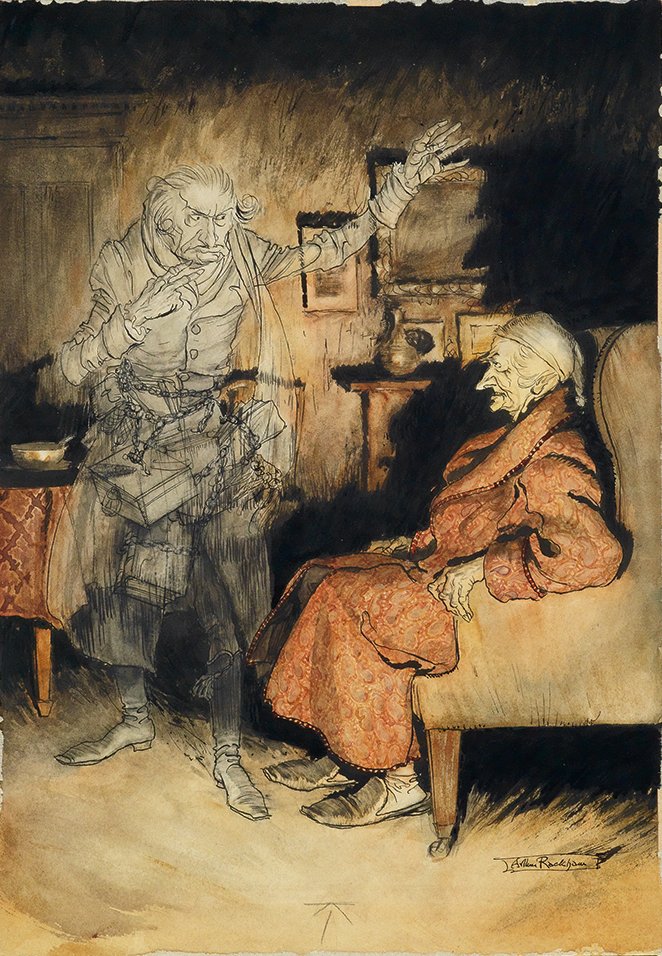
Jacob Marley’s Ghost… did you catch this?

As written works of literature become more familiar, we often lose the lessons the authors hide in the details. Whether you are discussing a familiar Bible story, or a piece of classic literature, the tendency is to drift toward the obvious story arc, and the moral thereof, missing the little nuggets and Easter eggs hidden along the way.

Such is the case with “A Christmas Carol,” by Charles Dickens.

So many of the details used in the story are often interpreted by the reader to simply paint the picture of who Ebenezer Scrooge was, and by extension who his late partner Jacob Marley was.

Scrooge was a heartless, bitter miser, no doubt formed by his meager, loveless upbringing and his pride in his own business dealings. Marley was like Scrooge, but being dead, was now condemned to an eternity of guilt, shame, and torment as a result of his sins against humanity.

The sins, by the way, were actually named in the book. Marley rejected any opportunity to help others, and thus was condemned to an eternity bound with chains, compiled by his many rejections of benevolence, and was doomed to watch helplessly as humanity suffered.

The other ghosts Scrooge was able to see during Marley’s visit suffered the same fate, with many giving futile efforts to help the living now that they had crossed into the afterlife.

Granted, none of this is scriptural, and Dickens wasn’t really trying to give us a Bible lesson, however, he was trying to give us a moral lesson.

Marley’s chains are often seen as the worst part of his condemnation, chains that were forged and linked by Marley’s own greed and disregard for others.

Those who read too fast, however, often miss what composed those chains.

Sure, the chains had your usual iron links that were looped together, but a major component of the chains were the cash boxes, bank books, deposit bags and ledgers that were connected.

Marley’s sin was driven by his love of money and his desire to be the shrewdest businessman in town.

As I was reading this, I began to think about the sins that would keep us out of Heaven, or the sins that could cost us in eternity. For many, there is a sin that is found so enjoyable that the sinner is reluctant to repent and turn to the Lord.

Thirty years ago, I drove across Northeast Texas listening to a radio show out of Dallas. It was a rock station with two “shock-jock” hosts who were interviewing an Independent, Fundamentalist Baptist pastor.

The radio hosts had no problem with the existence of God, or the Gospel message of the death, burial and resurrection of Christ. The problem they expressed, in a mocking tone, was that they enjoyed their sins of drunkenness, reveling, and sexual immorality.

While I believe the interview to have been a staged bit (my 20 years in broadcasting have ruined me to the notion that I will ever see or hear anything real in broadcast media), it did make an imprint on my mind.

How many people are so in love with their favorite sin that they are willing to wear the shame of it for eternity? How many people enjoy the pleasures of sin so much that they are positioning themselves for an eternity of condemnation as a result of it?

This is the condition Jesus speaks about in John 3:19-21, when He says, “And this is the condemnation, that light is come into the world, and men loved darkness rather than light, because their deeds were evil. 20 For every one that doeth evil hateth the light, neither cometh to the light, lest his deeds should be reproved. 21 But he that doeth truth cometh to the light, that his deeds may be made manifest, that they are wrought in God.”

Notice that. “This is the condemnation.”

Christ (the Light of the world) came into the world, but men loved darkness, because their deeds were evil. Choosing to cling to their beloved darkness and evil deeds, they avoided the Light so their deeds would not be reproved (confronted and corrected.)

In essence, people are building their own condemnation for eternity the way Jacob Marley built his own chains.

If you’re reading this and you don’t know Christ as your Savior, what sin are you willing to give up Heaven for? What sin do you want chained to you as you are condemned to Hell?

And if you do know Christ as your Savior, what sin are you willing to miss His blessings over?

The Christian faith, however, is not about condemnation and rejection. Rather, it is about seeing the blessing of redemption, the blessing of being freed from the chains of sin and being brought into an abundant life of Light, freedom and blessing. And all of this is given freely when the sinner decides they no longer want the darkness, when they no longer love the sin, but rather want the life, trusting that the life is given because Jesus bore the condemnation for their sin when He died upon the cross.

So, the main question is, which would you choose? The chains? Or Redemption?

Breaking down the #HeGetsUs campaign

Easily the most talked about, and most controversial commercial during the Super Bowl was a product of the #HeGetUs campaign. The marquee ad, entitled, “Love Your Enemies,” ran during the second half, as all the parties would have settled into the game and begun contemplating who would emerge as winner.

As you can see above, the ad featured 60 seconds of photos of conflict underlied by a soulful bluesy song by John “The Ragin’ Cajun” Jones called “I’m Only Human After All.”

The most controversial aspects of the ad are hard to determine. The fact that an organization is running ads to promote Jesus proved to be in and of itself controversial, as pundits across the spectrum questioned whether Jesus would have bought a Super Bowl ad, and whether the money could’ve been better spent feeding the poor.

While the Bible teaches mercy and benevolence toward the poor, those who have actually read the Bible know that in the New Testament, Jesus set the spread of the Gospel and the making of disciples as the top priority for the churches.

Such criticisms have even led many to call for taxing churches. However, the funds for the ads did not come from churches, but rather came from David Green, founder of Hobby Lobby, who literally made his fortune selling beads to hippies and soccer moms, and who gives half of the profits of Hobby Lobby away every year to organizations who spread the Gospel and provide relief to those in need.

Would Jesus buy a Super Bowl ad? I don’t know. But I do know that He would be pleased His name was proclaimed to millions without the neglect for the poor.

The second point of controversy was the confrontational aspect of the ad. The images of protest and conflict conjured up emotions of rage toward those on opposite sides of the political spectrum from us, then the message blindsided us with “Jesus loved those we hate.”

This message refers back to the words of Christ spoken during the Sermon on the Mount, and echoed by Dr. Martin Luther King, that we are to love our enemies. Love your opponents, and those who work against you.

The objective in loving our enemies is twofold, (1) To identify ourselves as God’s people and (2) to see our enemies redeemed.

This concept goes against our human nature, so we find it offensive. Yet, it’s not only Biblical, it was mandated by the Lord Himself, in the red letters, in the New Testament. There’s no getting around it. We are supposed to love our enemies.

Thus, there was an implied call to repentance in the ad. And that will always draw backlash.

Perhaps the final, and most controversial aspect of the ad was this… that Jesus loves those we hate. We have been conditioned to think that our enemies, our opponents, those different from us, are inherently evil and should be defeated and destroyed.

That is why our political discourse is as inciteful and incendiary as it is today. It’s not enough to defeat your opponent in a debate or in an election, you must also destroy his life so that evil can be vanquished and peace can permeate the world.

This mindset is wrong, because it’s false (opponents need to be won over, not destroyed) and based on a faulty premise. The wrath of man cannot bring the will of God, nor can it generate His peace.

However, when cable news, columnists and talk radio have convinced you that the other side is the embodiment of evil, the idea that Jesus could love them is startling.

Furthermore, if Jesus loves them like He loves me, then could He side with them also? Could Jesus possibly disagree with me?

And those questions drive the faith community, which easily drifts into self-righteousness, crazy.

A Jesus that disagrees with us is a Jesus that we still need to repent and turn toward, whose views we still need to conform ourselves to. And that means that it’s not just those we see as being lost that are being called to repentance, but it’s ourselves also.

That’s a confession too few of us are willing to make. Thus, the controversy surrounding this ad was near universal.

However, that doesn’t mean that the group behind the ad made a mistake. In his book, “Leadership Not By The Book,” David Green discusses the need to be disruptive, to shake things up and get people’s attention.

This ad was definitely disruptive. It broke our conventional thinking into what an evangelistic ad should look and feel like, and it broke cultural norms about who we perceive Christ to be. That forces us to either deny the Gospel, or re-center on who Christ really is and believe the true Gospel.

And because of that, I find the #HeGetsUs campaign to be hitting all the right points.

Confession to God

Photo by Ric Rodrigues on Pexels.com

Adam stood before the Lord guilty of breaking God’s one rule of the garden, he had eaten of the tree of knowledge of good and evil. Adam’s explanation? “The woman you gave to be with me gave me the fruit, and so I ate.”

David was confronted by Nathan the prophet after having an affair with the wife of one of his best soldiers before having that soldier killed to cover his sin. David’s response to being confronted with his sin? “Against thee, thee only have I sinned: and done this evil in thy sight…. Behold, I was shapen in iniquity and in sin did my mother conceive me.” (Psalm 51)

Which of these two men from the Old Testament offered God a true confession? If you answered David, you would be correct.

As we discussed in our previous post on confession, confession moves beyond an acknowledgement of one’s own action and admits fault, being transparent in one’s motivations and belief and placing one’s self at the mercy of another. Our previous exploration of the topic of confession was framed in the context of confessing our faults and struggles to each other, so that we can pray for one another, minister to one another, and be healed.

In this post, we will discover how this level of confession toward God not only brings forgiveness of sin, but also brings reconciliation to God and healing from the sin that has plagued one’s life. 1 John 1:9 says “If we confess our sins, He is faithful and just to forgive us our sins, and to cleanse us from all unrighteousness.”

According to 1 John, confession is the key that unlocks God’s forgiveness, cleansing, and thus healing. Denying sin, downplaying sin, or acknowledging the action without confessing that it is sin leads to a life marked by continued darkness, isolation and destruction. To deny sin is to call God a liar, which is the ultimate blasphemy, since lies are the hallmark of Satan.

Confession to God is made through one’s own prayer life, and while one may choose to confess their sin to their pastor, one has not truly confessed to God until one has approached God directly in prayer.

One of the great examples of confession in the Bible is the afore-mentioned Psalm 51. In it, David goes beyond confessing to his sins of adultery with Bathsheba and the subsequent murder of her husband. In fact, he does not even mention it. Rather, he focuses his confession on the very darkness within his own soul, and within his own heart that led to the sin.

In essence, David’s confession was not about the action, but rather the heart that birthed the action. His confession is like bypassing the symptoms in order to treat the disease itself.

In his Psalm 51 confession, David mentions that he is, at his core, a sinner. He then pleads with God to cleanse him, to create in him a clean heart, and to restore the joy of his salvation while restoring the fellowship he and God once enjoyed.

This level of confession is the mark of true repentance, to which God responds every time.

Another great example of confession in the Bible is Paul’s confession in Romans 7:15-25, where Paul confesses that no good thing dwells within him, therefore he is predisposed to rebelling against God’s law and leadership in his life. His confession is that he needs Christ to rescue him from the body of that death and to enable him to serve the Lord (Romans 7:24-25).

In Paul’s confession, we see the sinner move beyond confession and repentance and toward faith, as Paul’s only option is to trust the Lord.

Most people live life defeated. We sin, we face the consequence of sin, we promise God to never do that sin again if he will rescue us from the consequence, and then we go on and sin again. In this vicious cycle, we never confess what’s truly in our heart. In fact, we often deny it.

Furthermore, we never stop to consider the sin within our heart, and what it would take to be cleansed from that sin, if we even desire cleansing at all.

By stopping, assessing the sin within us, and confessing that sin to God, we can not only identify the cause of our destructive behavior, we can truly turn from it and allow God to heal that brokenness within us. Anything short of this is an exercise in futility.

With all this in mind, what will you confess to God today?