
The one thing that has challenged my faith

13350239_624569961040640_8092507861845382051_oA stranger knocked on my door one day.

“Hello, Mr. Acker. My name is Brother Turnbow.”

The elderly preacher was doing what he had spent his entire ministry doing. He was knocking doors to share the Gospel. I welcomed him to sit with me, told him I was also a pastor, and discussed with him the scriptures and the state of the world today.

The year was 2011, and I had just moved into my new house. Bro. Turnbow had gotten my name from the list of new water accounts opened with the city of Early. My heart had been heavy that week thinking about the rise of sin, and the animosity toward Christianity in society. Sin is taking our country down the hill of destruction, but the loudest voices in our society blame Christianity for the downfall.

That’s why a certain stanza from Marc Schultz’ song, “I have been there,” resonates with me:

He’s been a pastor 20 years, but tonight he sits alone and broken-hearted in the corner of the church.

Trying to change a fallen world, with his words and with his wisdom but it seems like it is only getting worse.

“Bro. Turnbow,” I asked, “Do you ever feel obsolete?”

Bro. Turnbow smiled and said, “As long as you preach God’s word, you are never obsolete.”

The problems of the world all come from unbelief. People distrust God, so they sin against Him, which causes all kinds of problems. It has been that way ever since Genesis 3, where Adam and Eve ate the forbidden fruit because they thought that God was holding out on them. Since then, the world has been in disarray, suffering from the effects of sin.

It is tempting to watch the demise of western civilization and conclude that, the end time is here, and Christ will soon return. He very well may, but to give up on the calling God has placed on your life is not only a dereliction of duty, but it expresses the same lack of faith shown by the generations before who “gave up” because of the changes in society, saying “Even so, come Lord Jesus.”

I was reading Luke 5 in my personal devotional time the other day, and Luke 5:17 struck me.

“And it came to pass on a certain day, as he was teaching, that there were Pharisees and doctors of the law sitting by, which were come out of every town of Galilee, and Judaea, and Jerusalem: and the power of the Lord was present to heal them.”

The power of the Lord was present to heal them. Heal who? The Pharisees and doctors of the law who sat by, watching in unbelief as Jesus taught the word of God and ministered to the people. These people were diametrically opposed to the message Christ brought, and his rise among the people. He was a threat to their influence and lifestyle, so they opposed Him.

Yet Luke 5:17 seems to indicate that the Lord had the power to heal their unbelief. And if the power of the Lord can heal the unbelief of some crotchety old Pharisees in the first-century AD, imagine what he can do for a world blinded by the selfish pursuit of pleasure.

Where my faith has fallen short in the past is that I failed to believe that God is the one who reaches people, convicts them, then redeems them. My faith has fallen short in believing that God can do that, and that He will do that. My faith has fallen short in believing that God WILL save, not just that He can.

That unbelief is in my past. I have repented from that sin, and now I am looking forward to seeing God move in mighty ways.

My wife once said, “True faith is realized when you no longer have to be the solution to the problem.” It would help us Spiritually, psychologically and emotionally to remember that the battle is the Lord’s. He will be the One who effects the change.

Our jobs are the same as the Apostles in Acts 5, who were told to “Go, stand and speak the words of this life.”

So, share the Gospel. Defend the faith. Preach the scriptures. But remember, the results are not up to you. Once you realize that, you’ll more fully understand “freedom in Christ.”

May God bless you in your Spiritual walk today.
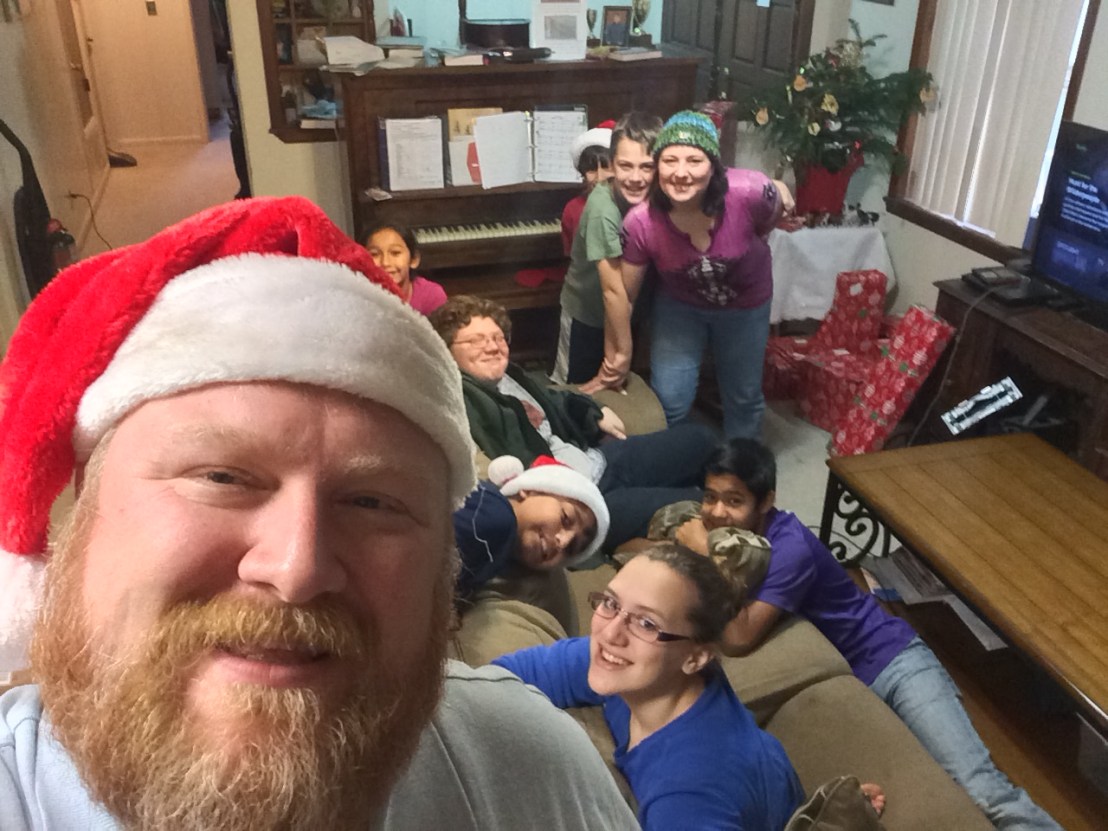
Why I celebrate Christmas with toys and trees…

15675996_10211148555255566_9200556580741383012_o

It was 10 p.m. last night, and the Walmart parking lot was still full. My wife and I had already hit the Heartland Mall looking for gifts for our seven children. Having loaded up on several gifts, we went to Walmart looking for toys to fill out the space beneath the Christmas tree.

Even at 10 p.m. in a small town like ours, traffic was heavy with holiday travelers and last minute shoppers. The shoppers had filled every store in town, dwindling the gift selections and extending the checkout times. Every year, this happens. Every year, I get caught up in the holiday rush, and every year I promise that next year will be different. I promise myself that, next year, I won’t wait until the last minute to buy my Christmas gifts. Then, every year, I do.

Those who know the true meaning of Christmas know that it has nothing to do with trees, Santa, or gifts. The true meaning of Christmas is remembering God’s promise to send us a Savior, His only begotten Son, who is Christ the Lord.

God stated that promise in Isaiah 7:14, when He promised that a virgin would conceive and bring forth a Son, and His name would be Immanuel, which being interpreted means “God with us.” He stated this promise again in Isaiah 9:6, “Unto us a child is born, unto us a Son is given.” Isaiah 9:6-7 promised that this child, God’s only begotten Son, would bring eternal peace and prosperity to us. This would be accomplished by redeeming us from sin (Isaiah 53) and by delivering us from the pain of this world, and healing us (Isaiah 61).

Scripture records how God kept this promise in Matthew 1-2, and Luke 1-2. Christ was born, went to the cross where He purchased our redemption, rose again to defeat death, and sits at the right hand of the Father advocating for us until the day God sends Him back to earth to establish His Kingdom and complete the promises of eternal peace, health and prosperity.

With that being the true meaning of Christmas, why was I in a supermarket checkout line last night with a buggy-load of Christmas presents, tired and exhausted from a long day? After all, my kids know the true meaning of Christmas. We could forego the tree and gifts, honor the birth of Christ by scripture reading, and then send money to less-fortunate people overseas. We could do that. The kids would go along with it. Instead, I have to ask myself what my true motivation in doing that would be.

Christmas was the defining event for the year in the house where I grew up. The entire family would converge on my grandfather’s house on Christmas Eve. It was a small farm house designed for a family of three, not to entertain dozens of guests. Still, every year, my mom and dad, uncle and aunt, great grandparents and great uncles and aunts, cousins, siblings, in-laws and even friends of the family, would come over, enjoy a Christmas dinner of turkey, dressing, ham, mashed potatoes, macaroni, etc etc etc and pecan pie, and celebrate the holiday.

Then, we exchanged gifts. Following the gift exchange, a televised basketball game, and some hilarious yet sentimental conversations, we’d all retire to bed. You read that right. This was a giant sleep over for adults and children. There were sleeping bags and fold-out couches. Sometime early on Christmas morning, before the sun rose, someone would loudly announce that Santa had come, and the gifts were out. We would then see what the jolly fat man brought us, collect our gifts, enjoy a breakfast of sausage, biscuits and dinner leftovers, and go home to recover. Those were good days.

We knew the true meaning of Christmas. There was a birthday cake for Jesus. There was the reading of the Christmas story. We celebrated in such a huge fashion because we were thankful for the family, friends and gifts God had blessed us with.

If the birth of Christ brought joy and peace, then why not celebrate His birth with a Christmas celebration that fosters joy and peace in our family? Celebrations like the one we will have this year, full of songs, gifts, and, of course, the scripture reading, brings joy and hope to our children, and that’s what I want to give them for Christmas. That’s why I braved the shopping crowds and holiday traffic, and that’s why I emptied my wallet. It’s a small price to pay to give the gifts of joy and peace to my kids, after the huge price the Lord paid to give joy and peace to me.

Merry Christmas. I’ll see you on the other side of the holiday.

PANIC!!!!!!

nancy pelosi
Photo by: Lorie Shaull

The late comedian Bill Hicks, whose stand-up routines offered fairly profane observations on life in the 1980s and early 1990s, was annoyed by the constant drumming of apocalyptic headlines by CNN.

“War, famine, death, aids, homeless, recession, depression,” Hicks chanted. “War, famine, death, aids, homeless, recession, depression. Then, you look out the window, and *crickets*.

“I want a (happy) Ted Turner newscast,” he continued. “‘Hey, everything’s great, here’s sports.”

Hick’s annoyance today could very likely expand to the Democratic Party, which has promised death and destruction with every piece of legislation, or executive action accomplished in 2017. Some of the farcical claims include:

-If the ACA is repealed, people will die in the streets.

-If net neutrality is repealed, people will die in the streets.

-If the individual mandate is repealed (the tax penalty levied on those who cannot afford insurance), people will die in the streets.

-The tax plan is the apocalypse.

-These tax cuts will have people dying in the streets.

Granted, these are hyperbole, but you get the idea. Still, I drive the streets in my neighborhood, and I haven’t seen one dead body yet. When is this mass extinction supposed to begin?

Now, I don’t mean to be partisan on this blog. In fact, I try to go out of my way to avoid beating the same political drums that form the cadence that is Talk radio and CNN.

Still, I am bothered by the fact that so much anger and fear can be galvanized so quickly by political operatives who have no real connection to the facts. Political action committees put out talking points, as do the leadership of both political parties, as do the political pundits, without really examining the details of the proposal.

The politicians need only give an 8-second soundbite to the news, and the political firestorms follows, all over issues that will have minimal impact on the daily lives of most Americans. Yet, to hear it said on TV, radio, in print, and on the street, “the end is near.”

Those at the top have no real incentive to change this dynamic. The votes of Congress are bought and sold by lobbying firms, regardless of which party is in power. As long as those lobbying firms continue to buy the elections of Congress, those elected have little reason to change, and the firms have no reason to change.

These same firms that buy the Congressional elections also invest in swaying public opinion, and they do so with much style and little substance, providing talking points to the media and members of Congress. So long as this model works, we will continue to see vitriolic political discourse and social volatility.

Therefore, it is our responsibility as individual citizens to break this cycle. It is up to us to demand more, and better information. It is up to us to demand accountability. It is up to us to research the candidates, and vote for the best candidate, not the best publicized candidate. If we continue our failure in this responsibility, then things will continue to get worse, because the current system is a multi-billion dollar industry making thousands of people rich.

Former FCC Commissioner Newton N. Minow once described television as “a vast wasteland,” saying that if you watched TV from sign-on to sign-off, a vast wasteland of sub-par programming is what you would observe. He said it was up to the public to demand better programming, adding that if the public continued to support bad programming, the vast wasteland would remain.

He said that no other bureau or agency could rectify the problem, that it was the duty of the American public to demand better. If they didn’t, then the vast wasteland would be their own fault.

The same holds true for our political system. As long as cable news ratings maintain, and lobbying firms continue to successfully purchase elections and votes, our political discourse will remain volatile, and the mass panic among the rank and file will continue. And we’ll only have ourselves to blame.

Primary election season starts now. Research the candidates, go to their public appearances, ask questions, then vote accordingly. Break the cycle, demand better.

Why we love Star Wars

Star_Wars_The_Last_JediMovies succeed at the box office due to effective marketing campaigns. Movie franchises, like Star Wars, the Hunger Games, or Jurassic Park, thrive because they either (a) mirror our lives or (b) speak into our human nature on a deep level.

Jurassic Park thrives because, in addition to capturing our imaginations through the resurrection of the dinosaurs, it poses the question as to whether man has the ability to create life, species, and whether we can overcome the natural order set forth by our Creator. Spoiler alert: We fail every single time.

The Hunger Games succeeded because it captured man’s natural desire to be free, the fact that hope never completely dies, and the lengths to which man will fight to win his freedom. All of that was embodied in the main character, Katniss Everdeen, who struggled through poverty, oppression, imprisonment, torture, and PTSD to lead a rebellion against a powerful overlord who subjugated everyone. Most who watched that series could identify with Katniss on some level, which is why the series succeeded.

The success of both of those franchises, however, pales in comparison to the success of the Star Wars franchise, which has become the definitive movie franchise for three generations due to the fact that it speaks into virtually every aspect of our lives, from our family life, to our professional life, to our philosophical life. Star Wars touches on family drama and pain, captures the plight of characters who are trying to overcome their station in life, and poses the bigger questions of life, liberty and the pursuit of happiness.

On this level, Star Wars speaks to our entire persona. We are all trying to make our way in this world, battling the elements of opposition as we try to climb the corporate ladder, move into the next tax bracket, or obtain the next level of education. While we fight those battles, we deal with issues at home. We struggle to repair or maintain relationships with our parents, to make our marriages work, to give our kids positive direction, and to keep from losing touch with those closest to us.

This multi-generational family story is laid against a back-drop of intergalactic battles, space ships, and planetary conquests.

In an interview after he sold the franchise to Disney, George Lucas said, “Star Wars isn’t about space ships and aliens, it’s about family.”

Those who understand that statement will understand Star Wars that much better. The franchise follows the plight of a single family, the children of Anakin Skywalker and Padme Amidala, as they learn their family history and fight to keep the galaxy free. Skywalker was overcome with rage and a desire to rule the galaxy, so Amidala took her two twins and hid them in separate places with friends and family.

Their circumstantial reunification and new-found purpose became the first Star Wars Trilogy, Episodes 4-6. In order to explain that trilogy, Episodes 1-3 were later released (for better or worse) in the 1990s. Now, we’re working on the third trilogy, which will follow the plight of the third generation of Skywalkers.

You see the family drama at work when Darth Vader is reunited with his son, Luke Skywalker, as well as when Hans Solo and Leia pine for their wayward son, Kylo Ren. Rey is trying to solve the mystery of who her family is, and why they left her on a desert planet, and Finn is the orphaned former Stormtrooper who’s searching for belonging.

You see the quest for betterment as Hans Solo continues his career as a smuggler, as inn-keepers and bar owners struggle to stay in business, or when Rey seeks Jedi training.

And then there’s the forbidden love between Anakin and Padme. Those two had to defy all customs and protocol in order to be together.

The issues that these characters deal with are issues we can all relate to. We’ve had family struggles. We’ve experienced lost love. Our kids have turned on us. We struggle to overcome, and we often feel like we get caught up in world affairs beyond our control.

And that’s why we love Star Wars. We see a little bit of ourselves in those characters, and so we root for them. We rejoice with them, we cry with them, and we die (figuratively speaking) with them.

Right now, critics and fans are debating whether “The Last Jedi” lives up to the hype. If it turns my life into another sci-fi thriller, it most certainly will.