Tag: sin

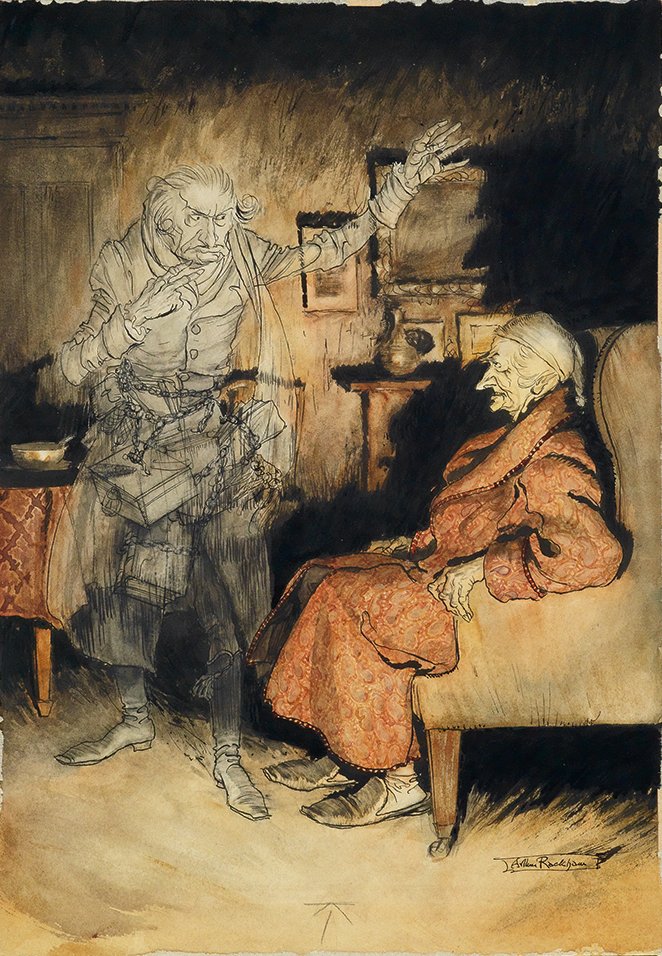
Jacob Marley’s Ghost… did you catch this?

As written works of literature become more familiar, we often lose the lessons the authors hide in the details. Whether you are discussing a familiar Bible story, or a piece of classic literature, the tendency is to drift toward the obvious story arc, and the moral thereof, missing the little nuggets and Easter eggs hidden along the way.

Such is the case with “A Christmas Carol,” by Charles Dickens.

So many of the details used in the story are often interpreted by the reader to simply paint the picture of who Ebenezer Scrooge was, and by extension who his late partner Jacob Marley was.

Scrooge was a heartless, bitter miser, no doubt formed by his meager, loveless upbringing and his pride in his own business dealings. Marley was like Scrooge, but being dead, was now condemned to an eternity of guilt, shame, and torment as a result of his sins against humanity.

The sins, by the way, were actually named in the book. Marley rejected any opportunity to help others, and thus was condemned to an eternity bound with chains, compiled by his many rejections of benevolence, and was doomed to watch helplessly as humanity suffered.

The other ghosts Scrooge was able to see during Marley’s visit suffered the same fate, with many giving futile efforts to help the living now that they had crossed into the afterlife.

Granted, none of this is scriptural, and Dickens wasn’t really trying to give us a Bible lesson, however, he was trying to give us a moral lesson.

Marley’s chains are often seen as the worst part of his condemnation, chains that were forged and linked by Marley’s own greed and disregard for others.

Those who read too fast, however, often miss what composed those chains.

Sure, the chains had your usual iron links that were looped together, but a major component of the chains were the cash boxes, bank books, deposit bags and ledgers that were connected.

Marley’s sin was driven by his love of money and his desire to be the shrewdest businessman in town.

As I was reading this, I began to think about the sins that would keep us out of Heaven, or the sins that could cost us in eternity. For many, there is a sin that is found so enjoyable that the sinner is reluctant to repent and turn to the Lord.

Thirty years ago, I drove across Northeast Texas listening to a radio show out of Dallas. It was a rock station with two “shock-jock” hosts who were interviewing an Independent, Fundamentalist Baptist pastor.

The radio hosts had no problem with the existence of God, or the Gospel message of the death, burial and resurrection of Christ. The problem they expressed, in a mocking tone, was that they enjoyed their sins of drunkenness, reveling, and sexual immorality.

While I believe the interview to have been a staged bit (my 20 years in broadcasting have ruined me to the notion that I will ever see or hear anything real in broadcast media), it did make an imprint on my mind.

How many people are so in love with their favorite sin that they are willing to wear the shame of it for eternity? How many people enjoy the pleasures of sin so much that they are positioning themselves for an eternity of condemnation as a result of it?

This is the condition Jesus speaks about in John 3:19-21, when He says, “And this is the condemnation, that light is come into the world, and men loved darkness rather than light, because their deeds were evil. 20 For every one that doeth evil hateth the light, neither cometh to the light, lest his deeds should be reproved. 21 But he that doeth truth cometh to the light, that his deeds may be made manifest, that they are wrought in God.”

Notice that. “This is the condemnation.”

Christ (the Light of the world) came into the world, but men loved darkness, because their deeds were evil. Choosing to cling to their beloved darkness and evil deeds, they avoided the Light so their deeds would not be reproved (confronted and corrected.)

In essence, people are building their own condemnation for eternity the way Jacob Marley built his own chains.

If you’re reading this and you don’t know Christ as your Savior, what sin are you willing to give up Heaven for? What sin do you want chained to you as you are condemned to Hell?

And if you do know Christ as your Savior, what sin are you willing to miss His blessings over?

The Christian faith, however, is not about condemnation and rejection. Rather, it is about seeing the blessing of redemption, the blessing of being freed from the chains of sin and being brought into an abundant life of Light, freedom and blessing. And all of this is given freely when the sinner decides they no longer want the darkness, when they no longer love the sin, but rather want the life, trusting that the life is given because Jesus bore the condemnation for their sin when He died upon the cross.

So, the main question is, which would you choose? The chains? Or Redemption?

This is What Got Them Banned from the Promised Land

Photo by Brett Jordan on Pexels.com

So, there were the Israelites. God had delivered them from the bondage of Egypt, saved them from the Egyptian army by parting the Red Sea, allowing them to pass on dry ground, led them with the pillar of cloud by day, and the pillar of fire by night, fed them with the manna and provided water for them, but here they stood on the edge of the Promised Land, uncertain if God will help them.

God told them to go into the land and take it. Instead, they sent in spies. Of the 12 spies that went in, 10 said the land was unconquerable. Only 2 said they could take it, because God was with them. The Israelites refused to go into the land and began considering whether to go back to Egypt.

This is the day the Lord calls “the provocation,” or “the day of temptation.” This is the day the Israelites unequivocably told God, “We don’t trust you.”

There is no greater sin against God than that… the sin of unbelief. The sin of refusing to trust Him.

Conversely, there’s no greater way to please God than to simply trust Him. It’s faith that impresses God. It was the faith of the centurion that caused Jesus to marvel. It was Abel’s faith that pleased God with his sacrifice. It was Abraham’s faith that made God want to make him the father of many nations.

It was David’s faith that labeled him, “A man after God’s own heart.”

But the Israelites in the wilderness?

They saw the plagues of Egypt. They experienced the deliverance through the Red Sea. They were fed miraculously. They witnessed the power of Mount Sinai.

Yet, here they are in the Promised Land, with God leading them in, and they refused to follow, because they didn’t believe. That, according to Hebrews 3, is what provoked the Lord to anger.

God then told the Israelites that they (that current generation) would never enter into the Promised Land. They would wander in the wilderness for 40 years before He would lead their children in.

As I sit here and type this, I wonder how they could be so faithless, after seeing God do so many mighty works in their presence. But then I think about my own faithlessness.

How often have I seen God come through for me. How often has He delivered me, carried me through a storm, and answered my prayers. Seeing God’s history of caring for me, why do I fear, even though the current storm seems to rage longer than the ones before?

This lack of faith comes from the hardness within my heart, which comes from me forgetting Who the Lord really is. I forget His love, His grace, His goodness and His character.

So, I allow my heart to become hardened with bitterness and unbelief sets in, which sets the stage for sin, and possibly a spectacular downfall.

Hebrews 3 gives us the remedy for this. Hebrews 3 encourages us to get to know the Lord better, to be vigilant against the hardening of our own hearts, to watch for unbelief creeping into our lives, and to gather together and encourage each other in our faith.

Wednesday night, 10/8/25, at 7 p.m., we will take a closer look at Hebrews 3 at First Baptist Church of Hermleigh, 483 Harlan Ave, Hermleigh, TX. We’d love to see you!

Not Even Satan Will Do This…

Photo by Andrea Piacquadio on Pexels.com

If you look at the world today, and examine human history, you will see that evil often runs rampant, and at times, seems unbridled.

In the years following World War II, hundreds of veterans surrendered to the ministry and returned to the fields in which they fought in order to deliver the Gospel. Whether it was the concentration camps of Germany, or the cruelty of the Japanese empire, these men saw what a dark place the world becomes when denied the light of the Gospel.

Rewind the clock a few centuries, and you will see the cruelty of the Inquisition, the Crusades, the Dark Ages (appropriately named), and the Romans had cruelty down to a science.

Today, the world remains a cruel place, with genocide being common in the third world, and human abuses and degradation common in the first world.

When one looks at the evil in the world, and comes to the realization that all this came into the world when man sinned in the garden at Satan’s temptation, one rightfully concludes that Satan is the source of the evil in the world.

Furthermore, one wonders just how much worse things can get? How much farther down this rabbit hole can society go?

We will learn that when the Great Tribulation comes. In the meantime, as we take all this in, it is interesting to note that there is one sin in which Satan has never been guilty. Atheism.

This notion hit me this morning when a quote from Charles Spurgeon popped up on my social media feed. Concerning atheism, Spurgeon said, “Atheism is a strange thing, even the devils never fell into that vice, for even the devils fear and tremble.”

Of all the lies, evil and sin that Satan has perpetrated onto the world through his willing accomplices, atheism is not one of them. Mainly because Satan knows as well as anyone the existence and power of God.

Which makes atheism even stranger. Because, despite the universal belief in God in the spiritual realm, and the centuries of wisdom guided by a belief in God (even among non-Christians), the modern atheist sees himself as wiser than everyone else. But, he’s a fool.

Psalm 14:1 says “The fool hath said in his heart, There is no God. They are corrupt, they have done abominable works, there is none that doeth good.”

The fool says in his heart, “There is no God.”

Romans 1:21-22 tells us that, “Because that, when they knew God, they glorified him not as God, neither were thankful; but became vain in their imaginations, and their foolish heart was darkened. 22 Professing themselves to be wise, they became fools.”

The modern atheist has rejected God, has convinced himself there is no God, and in doing so, has become vain (empty) in his thoughts and dreams, and darkness has filled his heart.

Even though he thinks himself wiser than those around him, he is a fool.

Both Psalm 14 and Romans 1 go on to show us the darkness and sin that follow once someone convinces himself that there is no God. But, there’s another side to this story as well.

Often, the fool that says in his heart, “There is no God,” is not an avowed atheist. In fact, he may even be a professing Christian. However, he is living as if God didn’t exist.

You see, to engage in sinful behavior, you have to at least temporarily convince yourself that either God does not exist, or that He is not watching, or that He doesn’t care. Because if you did believe in that moment that God was present, watching and that He cared, you wouldn’t do the sin you are about to do.

This is not something a Christian does consciously, but rather a state of mind one unknowingly enters into when they are in the process of backsliding. It works like this.

The Christian becomes lax in his Spiritual discipline. He is not praying as he should, is not spending time in God’s word, and is not gathering with his church. As he drifts, so does his consciousness about God.

As that consciousness about God drifts, so does the Christian’s moral compass. He begins to lose sight of his God-given responsibilities, of God’s authority and expectation, and finds himself justifying the things that please his flesh in the moment.

As he does this, he backslides. Until God intervenes and disciplines him. Then, he repents.

The backslide is foolish to the point that even the Christian thinks to himself, “What was I thinking?” Often, there’s no answer to that question. But we know what he wasn’t thinking… and that is that God is present, active, and watching. So, even though he didn’t say “There is no God,” he acted as if that were true, and thus acted foolishly.

When Satan sins against God, he does so in cognizant opposition to God with the misguided thought of either overthrowing God, or hindering His will. When man sins against God, it’s often with the misguided thought that God either doesn’t exist, or doesn’t care.

Don’t fall into that pitfall. We will sin. We will miss the mark. But let’s not backslide by neglecting our Spiritual lives, and let’s not fail to preach the Gospel to ourselves daily and remind ourselves of God’s truth.

Why the Gospel is Key

What is the point to Christianity? What is the central belief of the Christian faith?

I fear that for the most part, we’ve gotten so involved in preaching the Christian lifestyle and participation in faith communities that we have forgotten what it is truly all about.

In 1 Corinthians 15:3-4, Paul defines the Gospel as how Jesus Christ died for our sins, according to the scripture, was buried, and rose again the third day according to the scriptures.

The Gospel, the central message and belief of our faith, is that the Lord Jesus Christ became man, lived a sinless human existence, before going to the cross to bear the wrath of God for the sins of all mankind. Then, He rose again to defeat death and to give us all eternal life.

This is not only key to our faith and belief system, but it is absolutely necessary for us to have hope for life beyond this life, because faith in the Gospel is absolutely necessary to have our sins forgiven and to be given salvation and eternal life.

In the above posted message, we discuss the universal need for the Gospel.