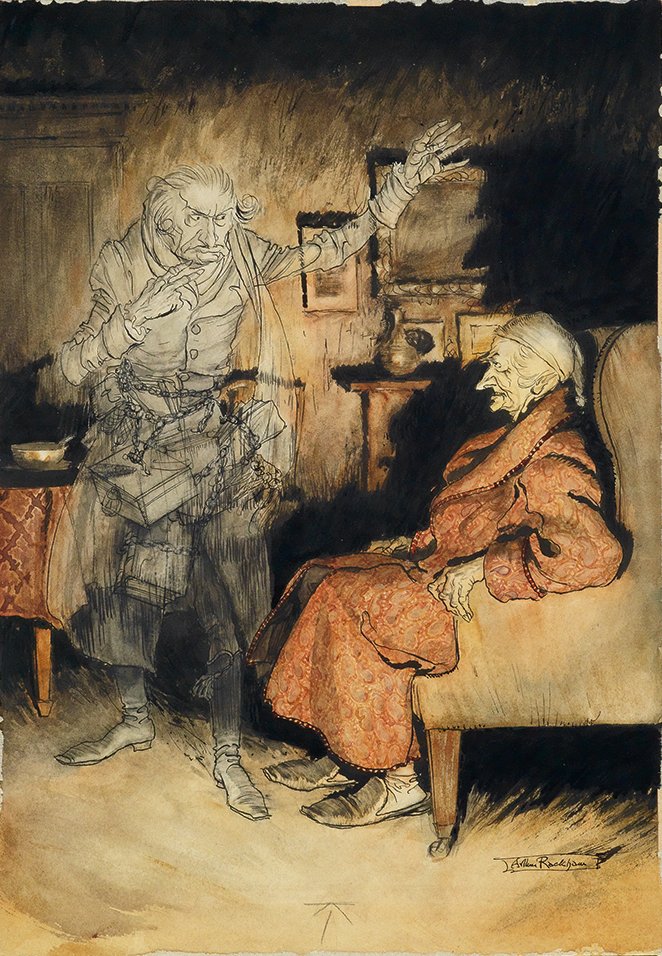
As written works of literature become more familiar, we often lose the lessons the authors hide in the details. Whether you are discussing a familiar Bible story, or a piece of classic literature, the tendency is to drift toward the obvious story arc, and the moral thereof, missing the little nuggets and Easter eggs hidden along the way.
Such is the case with “A Christmas Carol,” by Charles Dickens.
So many of the details used in the story are often interpreted by the reader to simply paint the picture of who Ebenezer Scrooge was, and by extension who his late partner Jacob Marley was.
Scrooge was a heartless, bitter miser, no doubt formed by his meager, loveless upbringing and his pride in his own business dealings. Marley was like Scrooge, but being dead, was now condemned to an eternity of guilt, shame, and torment as a result of his sins against humanity.
The sins, by the way, were actually named in the book. Marley rejected any opportunity to help others, and thus was condemned to an eternity bound with chains, compiled by his many rejections of benevolence, and was doomed to watch helplessly as humanity suffered.
The other ghosts Scrooge was able to see during Marley’s visit suffered the same fate, with many giving futile efforts to help the living now that they had crossed into the afterlife.
Granted, none of this is scriptural, and Dickens wasn’t really trying to give us a Bible lesson, however, he was trying to give us a moral lesson.
Marley’s chains are often seen as the worst part of his condemnation, chains that were forged and linked by Marley’s own greed and disregard for others.
Those who read too fast, however, often miss what composed those chains.
Sure, the chains had your usual iron links that were looped together, but a major component of the chains were the cash boxes, bank books, deposit bags and ledgers that were connected.
Marley’s sin was driven by his love of money and his desire to be the shrewdest businessman in town.
As I was reading this, I began to think about the sins that would keep us out of Heaven, or the sins that could cost us in eternity. For many, there is a sin that is found so enjoyable that the sinner is reluctant to repent and turn to the Lord.
Thirty years ago, I drove across Northeast Texas listening to a radio show out of Dallas. It was a rock station with two “shock-jock” hosts who were interviewing an Independent, Fundamentalist Baptist pastor.
The radio hosts had no problem with the existence of God, or the Gospel message of the death, burial and resurrection of Christ. The problem they expressed, in a mocking tone, was that they enjoyed their sins of drunkenness, reveling, and sexual immorality.
While I believe the interview to have been a staged bit (my 20 years in broadcasting have ruined me to the notion that I will ever see or hear anything real in broadcast media), it did make an imprint on my mind.
How many people are so in love with their favorite sin that they are willing to wear the shame of it for eternity? How many people enjoy the pleasures of sin so much that they are positioning themselves for an eternity of condemnation as a result of it?
This is the condition Jesus speaks about in John 3:19-21, when He says, “And this is the condemnation, that light is come into the world, and men loved darkness rather than light, because their deeds were evil. 20 For every one that doeth evil hateth the light, neither cometh to the light, lest his deeds should be reproved. 21 But he that doeth truth cometh to the light, that his deeds may be made manifest, that they are wrought in God.”
Notice that. “This is the condemnation.”
Christ (the Light of the world) came into the world, but men loved darkness, because their deeds were evil. Choosing to cling to their beloved darkness and evil deeds, they avoided the Light so their deeds would not be reproved (confronted and corrected.)
In essence, people are building their own condemnation for eternity the way Jacob Marley built his own chains.
If you’re reading this and you don’t know Christ as your Savior, what sin are you willing to give up Heaven for? What sin do you want chained to you as you are condemned to Hell?
And if you do know Christ as your Savior, what sin are you willing to miss His blessings over?
The Christian faith, however, is not about condemnation and rejection. Rather, it is about seeing the blessing of redemption, the blessing of being freed from the chains of sin and being brought into an abundant life of Light, freedom and blessing. And all of this is given freely when the sinner decides they no longer want the darkness, when they no longer love the sin, but rather want the life, trusting that the life is given because Jesus bore the condemnation for their sin when He died upon the cross.
So, the main question is, which would you choose? The chains? Or Redemption?

 Leland Acker