The Apostle Paul makes the case that once you are saved, you cannot lose salvation, because God’s love (grace) is the driving force behind your salvation.
Category: Life
It’s Time for the Great Pumpkin!

For some reason, I always identified with Charlie Brown. I always understood his plight. Nothing ever seemed to work out for him, and he always seemed to be laughed at.
Which is one reason why, when Halloween rolled around, I always enjoyed watching “It’s the Great Pumpkin, Charlie Brown.”
The show was whimsical and full of childhood experiences with ironic twists. In a time designed to scare people, it was just plain fun.
Which is what the Halloween holiday has become in our culture… just plain fun.
Kids dress up in costume and “play-pretend.” Sometimes, even adults dress up as well… not just for the children’s Halloween party later that day, but for work as well. Walk into any insurance office, and you may find Elsa from Frozen, the Wicked Witch of the West, or Morticia Adams.
The objective for the kids is simple… leverage your Halloween costume as best as possible for as much candy as possible. In the words of Sally from the Charlie Brown Christmas Special, “Get while the gettin’s good.”
That will be the objective this evening, as a trunk or treat will be held in the parking lot of Spieker Stadium before tonight’s game between Hermleigh and Ira.
It may seem like good clean fun, but is it?
While the face paint is being applied, and costumes are being fitted, blogs and social media posts from various individuals and groups are criticizing Halloween as a satanic holiday and urging people not to participate, even in fall festivals and trunk or treats.
Are they correct?
To explore this, we’ll look to two sources. Bro. Ray Brooks, who served as president of Texas Baptist Institute-Seminary, and Romans 14.
It was approximately 21 years ago, on the morning following Halloween. Apparently, none of us had the nerve to celebrate the holiday around campus or in student housing. I vividly remember panicking when my classmate and next-door neighbor, Mike Gribble, caught me in the act of making a Jack-O-Lantern.
Mike, great man of God that he is, and gracious as he is, gave me a devotional about how the transformation of the pumpkin into a Jack-O-Lantern is similar to our transformation in Christ. Thus, I could now legitimately make a Jack-O-Lantern (my favorite activity of Halloween.)
Almost all of us were married with children, living in seminary-owned apartments and houses. Some of us stayed home. Some went to fall festivals hosted by our respective churches. Apparently, no one took their kids trick or treating around the neighborhood, and absolutely no one took their kids trick or treating to the president’s door.
He expressed his disappointment the following day in chapel, telling us to “let the kids have fun.”
The argument against Halloween centers on the holiday’s pagan roots. Yet, I don’t believe anyone can say with a straight face that a young girl dressed up as Princess Elsa, or a young boy dressed up as Chewbacca, are really trying to engage in spiritualism or the worship of the occult. And worshipping the occult and summoning satan is not something you do accidentally.
The holiday may have been rooted in the occult centuries ago, but the modern version centers around costumes, imagination, play-pretend, and candy. There’s no spiritualism to it. It’s just good plain fun.
If pagan roots are to deter us from celebrating holidays, then we have to wipe Christmas and Easter off the calendar as well. Both were created as the Catholic church co-opted pagan holidays and rebranded them as Christian in order to convert pagan tribes to Christianity.
But, when Christians celebrate Christmas, they’re not celebrating a pagan season. They’re celebrating the birth of Christ. When they celebrate Easter, they’re not celebrating a Norse god, but rather the resurrection of Christ. (The eggs and bunnies are just an excuse to eat more chocolate.)
While some have taken the step of refraining from celebrating Christmas and Easter, others understand that the holiday is what you make it, and meanings change over time.
Christmas may have started as a pagan holiday, but Christians made it their holiday, and Coca-Cola made it a retail holiday. The Christians I know center that day and the entire month on the birth of Christ.
Easter may have started out as a pagan holiday, but Christians made it their holiday, and Hershey, Mars and Nestle made it a chocolate holiday.
And Halloween may have been a pagan holiday, but Americans turned it into a chocolate and candy corn holiday.
Basically, what you celebrate is determined by what’s in your heart. Are you celebrating Christ, cola, new toys, debunked ancient gods, or chocolate?
In the case of Halloween, it’s chocolate.
Now, all of this sounds good, but where’s the scripture?
Romans 14:1-8 says, “Him that is weak in the faith receive ye, but not to doubtful disputations. 2 For one believeth that he may eat all things: another, who is weak, eateth herbs. 3 Let not him that eateth despise him that eateth not; and let not him which eateth not judge him that eateth: for God hath received him. 4 Who art thou that judgest another man’s servant? to his own master he standeth or falleth. Yea, he shall be holden up: for God is able to make him stand. 5 One man esteemeth one day above another: another esteemeth every day alike. Let every man be fully persuaded in his own mind. 6 He that regardeth the day, regardeth it unto the Lord; and he that regardeth not the day, to the Lord he doth not regard it. He that eateth, eateth to the Lord, for he giveth God thanks; and he that eateth not, to the Lord he eateth not, and giveth God thanks. 7 For none of us liveth to himself, and no man dieth to himself. 8 For whether we live, we live unto the Lord; and whether we die, we die unto the Lord: whether we live therefore, or die, we are the Lord’s.
In all truth, the context of these verses deal with the Old Testament Jewish feasts and festivals. Still, the concept remains. Some eat, some don’t. Some celebrate holidays, some don’t. The ones who eat, do so with thanksgiving and eat unto the Lord. The ones who don’t, refrain from eating in order to honor the Lord.
Those who celebrate holidays do so for the Lord. Those who don’t celebrate refrain for the Lord.
So, regardless of which camp we fall in, we belong to the Lord and we live for the Lord.
The point to Romans 14 is that we are to leave each other alone and allow each other to live for the Lord in a way that our conscience can be settled.
So, at Christmas, if you want to celebrate Jesus’ birthday, please do so with your whole heart. And if you’d rather not celebrate Christmas, then honor God with your non-observance.
At Easter, if you want to celebrate the resurrection of Jesus, then do so and glorify God by proclaiming the Gospel. If you want to refrain from celebrating Easter, then honor God by regarding every Sunday as resurrection day.
And at Halloween, if you want to play dress-up and eat candy, have fun! For God never forbad fun. But, if you’re uncomfortable participating, then you are honoring God with your abstention.
But no matter what you do, recognize that we are all brothers and sisters in Christ. That we are all honoring and living for God as best we know how, and that there are times that we need to step back and let God work the relationship between Himself and His people. Meanwhile, we keep our fellowship between each other.
But… one hill I will die on… unless you are a severe diabetic, chocolate is always appropriate.
May God bless you with a wonderful evening this evening, and a beautiful autumn weekend.
We Didn’t Realize Where We Stood

It was Saturday afternoon, sometime in late 1997. I sat in a booth at the Pizza Hut in Jacksonville, Texas, waiting for my personal pepperoni pan pizza.
They brought that delicacy out in a piping hot iron pan and served it to you right there on your table, pan and all. I was already sipping on my soda, served in one of Pizza Hut’s iconic red plastic cups.
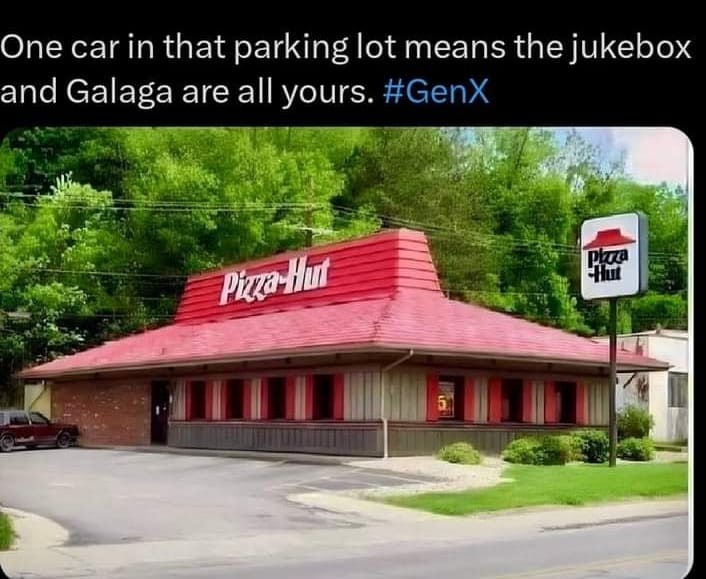
The jukebox was jamming out to an old AC/DC song and I was looking forward to a big night at my best friend, Ronnie’s, house. We were going to, once again, attempt to conquer “Tomb Raider” on the first-generation PlayStation system. If Ronnie ever beat that game, I wasn’t there for it.
Sunday night would see my return to college at Stephen F. Austin State University, where I would wake up at 9 a.m. on Monday just in time to make it to my 10 a.m. broadcasting class before going to lunch at East Cafeteria, where I would be treated to all-u-can-eat flame broiled hamburgers, and “Silver Springs” by Fleetwood Mac playing on the jukebox.
Fleetwood Mac… in a few months, I would be able to attend their tour, “The Dance,” at the Coca Cola Starplex in east Dallas. That show was perfectly choreographed, with every move, note and song matching Fleetwood’s PBS special that aired earlier that year. The only thing missing was the USC Marching Band. Not a bad show for $10.
No bills. Inexpensive entertainment. And disposable income. No worries, just how to entertain myself next. Life at the age of 19… as it should be.
Life was good. Those were the “good ole days.”
In 2016, Donald Trump ran for his first term in office under the slogan, “Make America Great Again.” At the time, I was co-hosting a talk radio show with my good friend, Brian Wade. We theorized that, if Donald Trump wanted to “make America great again,” then there must be a time in American history that he was looking back on which he perceived America to be greater than it is today.
So, we went on the air and asked our audience to call in. Tell us, “When was America greater than it is now?”
Our audience gave different answers, ranging from the 1950s to the 1990s. What we found was that most people saw America at its greatest around the time they turned 18… when the benefits of earning money and starting their lives were first being realized, but before the realities and burdens of adult life set in.
For most, America was at its finest, not when the markets rallied or the wars were won, but when their lives were good. One man even said America was at its best in the late 1970s. The voters in the 1980 election beg to differ, but in the late 70s, this man had a good job, a good home, and a good family.
The good ole days.

What I didn’t realize in August of 2016, as Brian and I were creating the best radio that Brownwood, Texas, has ever heard, was that in a few short months, Brian would be called home to Heaven after suffering a pulmonary issue.
We never really know where we are standing, how good the time is, and how fleeting that moment truly is.
Adam and Eve stood in the garden of Eden… a perfect life, everything they could want, no problems. But… they didn’t realize where they were standing, how good things were, and how that paradise would be lost once they rebelled against God.
I wonder if Adam and Eve ever felt nostalgic for the Garden, the way we often feel nostalgic for our lost youth?
Nostalgia…
Nostalgia is an English word that descends from two ancient Greek words, Nostos (homecoming) and algos (pain.) It’s a sentimental longing for a period in the past, often accompanied by the pain of grief over the innocence and youth lost, the time past, and friends and family who have passed on.

What does scripture say about nostalgia?
Very little.
Ecclesiastes 7:10 warns us, “Say not thou, What is the cause that the former days were better than these? for thou dost not enquire wisely concerning this.” That the ongoing longing for times that seem better than now is not wise.
Philippians 3:13-14 tell us “Brethren, I count not myself to have apprehended: but this one thing I do, forgetting those things which are behind, and reaching forth unto those things which are before, 14 I press toward the mark for the prize of the high calling of God in Christ Jesus.”
In both verses, we are warned against living in the past, but that doesn’t mean that it’s a sin to remember the past. Rather, when we remember the past, we do so with purpose, remembering God’s goodness, blessings and mercy, while at the same time looking forward to what He will do next.
So, to help us with this, let’s keep a few things in mind.
First, realize that when we look back on memories, we tend to look back with rose-colored glasses. Truth be told, the good ole days weren’t always that good.
Sure, America was prospering in the post-war years of the 1950s, but we faced a polio epidemic and the threat of nuclear annihilation at the hands of the Russians.
The 1960s might have been fun, but that’s only if you forget the near collapse of the American government and economy in the aftermath of the Kennedy assassination and the dark forces that were truly driving the counter-cultural revolution.
The 1970s may have had good movies and music, but stagflation wiped out the income of American workers and there were gas shortages.
The 1980s brought us AIDS. The 1990s brought us scandal, divisive politics and the beginnings of global terror.
I mean, Billy Joel has a hit song from the 1980s about all the challenges that post-war America faced.
Secondly, realize that today isn’t all bad. Yes, the simplicity of last century is gone, and the world we grew up in will never return. However, from the 1950s through the 1990s, generations back then grieved the changes that were taking place. Yet, today, we look back on those years as the good ole days, remembering some really good things about the times we complained about back then.
Everything is different now, and there are a lot of anxieties to daily life now. Cell phones and remote work has isolated us. Entire communities are disappearing even though the houses and people remain.
Yet, good things are happening today.
On a Spiritual level, I don’t think I have ever seen a younger generation so inquisitive and accepting of Biblical truth as the young Gen-Z, and Gen-Alpha. While social media shows the extreme left-wing and atheistic wing of those generations, in real life, there are multitudes of young people who are not only open to the Gospel, but crave a deeper understanding of the scriptures.
They seek what’s real. And, we as Christians and churches have the opportunity to cultivate that curiosity and foster that growth in faith in these younger generations that could spark a revival such as we have not seen since the 1950s.
Furthermore, if we take stock of our own lives, and take the time to count the blessings God has given us, we will find that, national and global issues notwithstanding, life is still good.
And finally, it will help if we remember that there is still purpose to life. If you opened your eyes this morning, God still has a purpose for your life. If you are still breathing, God is still working with you.
Sometimes, we go through seasons where we feel that we no longer have a reason to live. There’s no more purpose to life.
This is very common for empty nesters whose children have just moved out of the home. This is also common for retirees who have no idea what to do now that there’s no longer a career to wake up to.
It may take some time, but God will lead you to your purpose. Take this time to rest and to get into His word, and gain more understanding of him. Also, take a road trip, or go fishing. Enjoy life.
And as you enjoy it, just know that there is still purpose to life.
As we follow these steps, we will find ourselves less bereaved over the passing of the good ole days, and more purpose-driven, making these current days the good ole days. As we do that, we may even see the Kingdom of God advance.
May God bless you richly today.
Look at that Happiness!

Sometimes, it pays to stop and take stock of how far God has brought you, and where God has placed you.
In the opening words of Psalm 21, King David says, “The king shall joy in thy strength, O Lord; and in thy salvation how greatly shall he rejoice! 2 Thou hast given him his heart’s desire, and hast not withholden the request of his lips. Selah.”
The word “Selah” indicates a pause, and a reflection. King David is pausing to reflect on the words he just lifted up to God.
The first thing he said is, “The king shall joy in thy strength, O Lord.”
“The king…”
King David does not usually refer to himself in the third person like this, and he usually doesn’t refer to himself as king, at least, not in the psalms. Yes, he was the rightful king of Israel, so ordained by God, but David didn’t go around boasting his title. Instead, he was just king. He just did what God wanted him to do.
But here… David calls himself king. He is taking stock of where God has placed him.
No longer is he the shepherd boy living outside Bethlehem, he is king of Israel.
And his rise to power and prominence wasn’t the result of his own political abilities, nor was it the result of his own conquest, rather it was God who elevated him to that role.
The king shall joy in the strength of the Lord.
Here, David’s reflection moves beyond where God has placed him to the power and magnificence that defines the Lord’s character.
God’s strength is more powerful than anything we can imagine. As the creator of the universe, He has the ability to speak things into existence and to alter the course of time, and the composition of matter simply by desiring it.
This power is seen on full display in John 2, where Jesus turns the water into wine simply by willing it to change.
This God, with all His power and authority, had enveloped David in His good will. That same God, with the same power and strength, envelopes us in His good will as well.
Not only did God create us and give us life, but He used His power and authority to redeem us from sin and death. He then uses His power and strength for our good, as Romans 8:28 says that “All things work together for good to them that love God, to them who are the called according to his purpose.”
Romans 8:31 goes on to reinforce the truth that God wants, and will do, good for us. “What shall we then say to these things? If God be for us, who can be against us?”
So, in Psalm 21, David is taking stock of where God has placed him, and Who God is, and is celebrating the Lord’s salvation. He goes on to reflect all the prayers God has answered, and all the requests God has granted. This all culminates with David, once again, expressing faith and joy in the Lord.

In life, there always seems to be another mountain before us. We always seem to be facing another obstacle, another crisis, another problem, and another challenge to our faith.
And, even though we have our meltdowns and our breakdowns, we always seem to find a way to pray it out before God and move forward in faith.
But… one of the great tragedies in life is to miss the blessings you’ve already been granted because you are too focused on your problems.
So, we must intentionally stop, take a moment, reflect on Who God is, remembering His goodness, then take the time to count the blessings. Yes, there may be a mountain before us, but how about that mountain He already carried us over, and how about this beautiful valley in which we stand?
Even though I still have remnants from my past life stressing me out, it helps to start my day in the Lord’s presence with prayer and devotional time (which produces many of these blog posts). And centering my day on the Lord helps me to appreciate not only the past blessings, but the beauty and amazement of the place where I am now, and the new life He’s given me.
Take time to remember your blessings and praise the Lord for them today. You’ll be glad you did. It will lift your spirits.
 Leland Acker